
Future Frontiers - Issue 1
Welcome to Future Frontiers Newsletter
In this issue:
Introduction: Why I started the Future Frontiers Newsletter
Focus Feature: The Fifth Revolution
Free Artifact: The Human-AI Collaboration Playbook
Demystifying AI: Agentic AI
Leadership Lessons: Cummins: Calm, Trust, and Resilience Win the Game
Wise Words: Arthur C. Clarke
Brain Teaser
Quizzical
Just In Jest
Future Frontiers:
Why I Started This Newsletter
Last week, I read about a CEO describing their AI strategy using the same language they used for their cloud migration five years ago. "We're going to digitize everything and become more efficient."
Mind you, the CEO was an intelligent person with a successful track record navigating the financial crisis and the pandemic. However, the fundamental flaw in this thinking is trying to fit the future into the frameworks of the past.
Focus Feature:
The Fifth Revolution
Welcome to the inaugural issue of Future Frontiers. I'm writing this as someone who has spent years watching patterns emerge from data, seeing intelligence take shape in silicon, and wondering what it all means for us as a species. Today, I want to step back from the daily drumbeat of AI announcements and ask a bigger question: where does artificial intelligence fit in the grand sweep of human technological evolution? Of course, I am a student and practitioner of technology, and do not have all the answers.
Free Artifact :
Human AI Collaboration Playbook
The future of work isn't about humans versus AI—it's about humans with AI. As artificial intelligence becomes more capable, the question isn't whether to collaborate with these systems, but how to do it effectively.
This playbook distills insights from early adopters, researchers, and practitioners who are already navigating this new frontier. These twelve principles aren't theoretical frameworks—they're practical wisdom from organizations that have learned to navigate and leverage artificial intelligence.
Demystifying AI:
Agentic AI
Think of this as AI that can actually do things, not just answer questions. Instead of being a passive tool that waits for commands, agentic AI takes initiative. It can plan multi-step tasks, make decisions along the way, and execute actions in your systems. Picture an AI assistant that doesn't just tell you what meetings to schedule—it actually schedules them, sends the invites, and follows up. It's the difference between having a research intern who gives you reports versus hiring a project manager who gets things done.
Leadership Lessons:
Calm, Trust, and Resilience Win the Game
Those who know me are aware that I am an avid cricket fan. I think one can glean insights and leadership lessons from cricket (as well as many other sports, arts, and life in general).
During the 2023 Cricket World Cup, Australian captain Pat Cummins led his team to victory despite early setbacks. Australia lost its first two matches, prompting critics to question Cummins’ tactical decisions. Yet, he remained calm, backed his players, and fostered a resilient team culture. By the tournament’s end, Australia dominated, winning nine straight games—including the final against India. (Needless to say, I was sad that India lost.)
Wise Words:
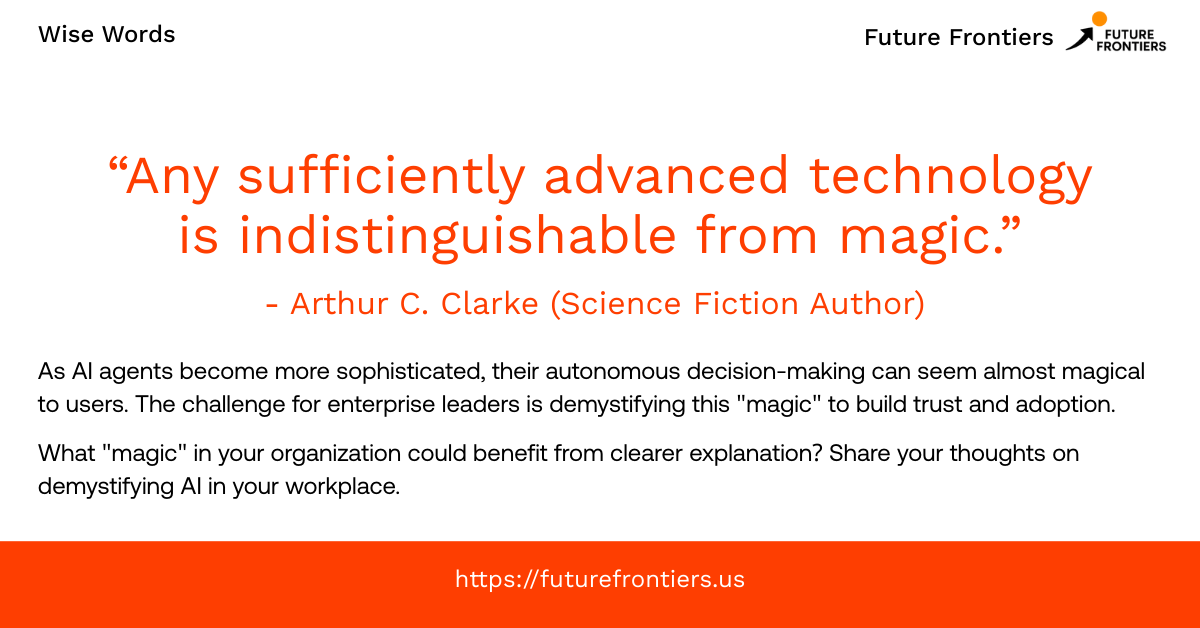
"Any sufficiently advanced technology is indistinguishable from magic."
- Arthur C. Clarke (Science Fiction Author)
As AI agents become more sophisticated, their autonomous decision-making can seem almost magical to users. The challenge for enterprise leaders is to demystify this "magic" and build trust and adoption.
What "magic" in your organization could benefit from a clearer explanation? Share your thoughts on demystifying AI in your workplace.
Brain Teaser :
The Agent Delegation Dilemma
You manage three AI agents with different capabilities:
Agent A completes any task in 3 minutes but makes errors 10% of the time
Agent B completes any task in 6 minutes with 100% accuracy
Agent C can verify any completed task in 1 minute with perfect error detection
You have five identical critical tasks that must be completed with zero errors. What's the most efficient strategy to complete all tasks?
Quizzical :
What's Your AI Readiness Level?
Question 1: What percentage of business processes in most enterprises are currently fully automated?
a) 15-25%
b) 35-45%
c) 55-65%
d) 75-85%
Question 2: Which factor is most critical for successful AI agent implementation?
a) Having the latest technology
b) Large training datasets
c) Clear process documentation
d) Unlimited budget
Question 3: What does "human-in-the-loop" primarily ensure in agentic systems?
a) Cost reduction
b) Speed optimization
c) Quality oversight and control
d) Regulatory compliance only
Question 4: In process intelligence, what is "telemetry of work"?
a) Employee time tracking
b) Real-time capture of work patterns and behaviors
c) Financial performance metrics
d) Customer satisfaction surveys
Question 5: What's the biggest barrier to AI adoption in enterprises?
a) Technical complexity
b) Cost considerations
c) Organizational resistance to change
d) Lack of available technology
Just In Jest :
Digital Twin Problems
My digital twin is apparently much more organized than I am. It's been sending passive-aggressive emails about my desk setup.
{Remember: The future is all AI and automated, but the laughs are still authentically human. At least for now.}
Brilliant. The point about fitting the future into past frameworks is so crucial. Realy excited for this newsletter.