
Future Frontiers - Issue 5
In this issue:
Focus Feature: Beyond RPA: The Great Automation Renaissance
Free Resource: 7 Agentic AI Governance Principles for Enterprise Leaders
Data Drop: How Long Before Your Models Go Stale?
Demystifying AI: Neural Network
Leadership Lessons: Tenzing Norgay's Shared Glory
Wise Words: The future is already here
Brain Teaser: The Trust Calibration Challenge
Quizzical: Data Intelligence Mastery
Just In Jest: Agentic Expectations
Focus Feature:
Beyond RPA: The Great Automation Renaissance
The obituary for Robotic Process Automation has been written prematurely many times. Critics dismiss it as "glorified screen scraping." Advocates defend it as the foundation of digital transformation. Both camps are missing the bigger picture.
RPA wasn't the destination—it was the dress rehearsal.
We're now witnessing something far more profound: the emergence of brilliant automation that not only follows scripts but also thinks, adapts, and collaborates. This isn't RPA 2.0. It's an entirely new species of digital workforce that's rewriting the rules of what machines can do in the enterprise.
Free Resource :
7 Agentic AI Governance Principles for Enterprise Leaders
A Fortune 500 client's procurement AI agent nearly ordered $2.3 million in office supplies. The culprit? A decimal point error in the training data that nobody caught until the system started "helpfully" stocking every floor with 10,000 staplers.
This wasn't a failure of the technology. It was a failure of governance.
As we transition from observing and reporting to autonomously executing, the stakes have fundamentally changed. Traditional IT governance frameworks weren't designed for systems that make decisions, take actions, and learn from outcomes without constant human oversight.
Data Drop:
How Long Before Your Models Go Stale?
Drift Time Stats by Industry. The clock starts ticking the moment you deploy that shiny new ML model.
Here are model drift patterns across industries, and the numbers tell a sobering story. Your carefully trained algorithms don't age like fine wine—they decay like produce left in the sun.
Demystifying AI:
Neural Network
At its core, a neural network is a sophisticated pattern recognition machine inspired by the biological architecture of the brain. Imagine a vast, interconnected web of simple processing units, called neurons or nodes. These nodes are arranged in layers: an input layer to receive data, one or more hidden layers where the actual processing happens, and an output layer that delivers the final result. Each connection between these nodes has a "weight," which is essentially a number that signifies the strength and importance of that connection.
Leadership Lessons:
Tenzing Norgay's Shared Glory
Recently, I came across this nugget, and upon reflection, I believe it's an excellent lesson for those of us who manage people. When Tenzing Norgay and Edmund Hillary became the first to summit Mount Everest, reporters asked who reached the top first. Tenzing refused to answer, saying they climbed as a team. This wasn't modesty—it was strategic leadership that maintained partnership integrity for future expeditions.
Wise Words:
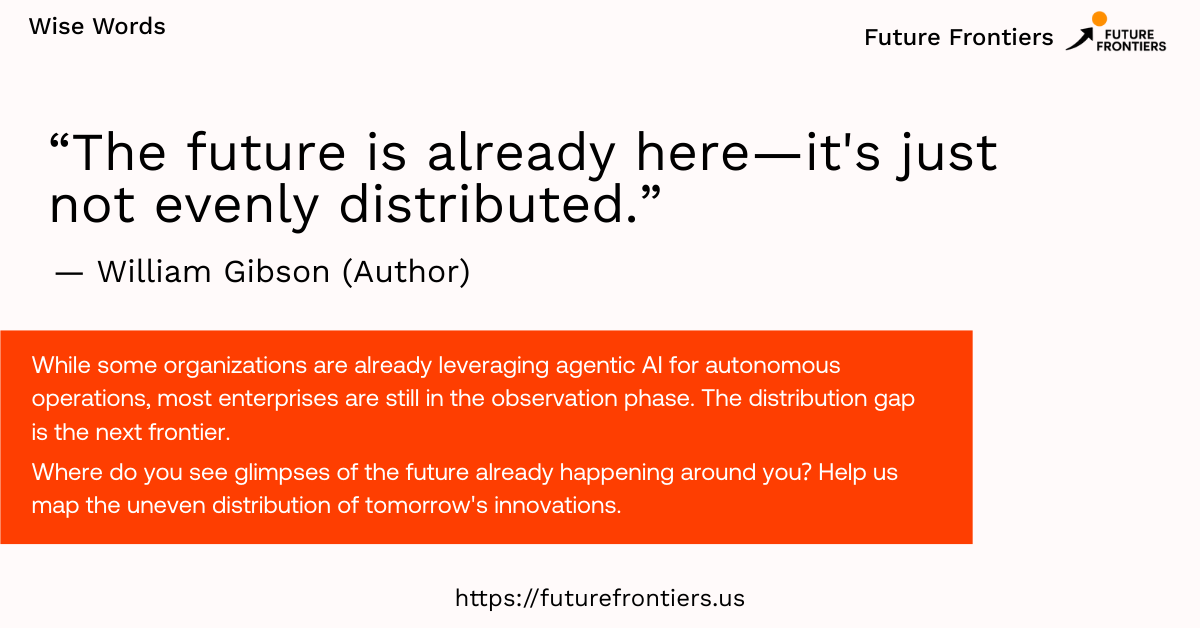
"The future is already here—it's just not evenly distributed."
— William Gibson (Author)
While some organizations are already leveraging agentic AI for autonomous operations, most enterprises are still in the observation phase. The distribution gap is the next frontier.
Where do you see glimpses of the future already happening around you? Help us map the uneven distribution of tomorrow's innovations.
Brain Teaser :
The Trust Calibration Challenge
An AI system's confidence correlates with accuracy as follows:
90-100% confidence: 95% accurate
80-89% confidence: 85% accurate
70-79% confidence: 75% accurate
Below 70% confidence: 60% accurate
If the system processes 1000 decisions with the confidence distribution: 200 high (90-100%), 300 medium-high (80-89%), 300 medium (70-79%), and 200 low (below 70%), how many decisions should you expect to be correct?
Quizzical :
Data Intelligence Mastery
1: What makes first-party data particularly valuable for AI?
a) It's free to collect
b) It's specific to your organization's unique context and processes
c) It's more accurate than third-party data
d) It's easier to process
2: What's the difference between data and intelligence?
a) Data is digital, intelligence is analog
b) Data is raw information, intelligence is processed insights
c) There is no difference
d) Intelligence is always more expensive
3: In process intelligence, what does "digital twin" refer to?
a) Duplicate employees
b) Backup systems
c) Virtual representation of real-world processes
d) Copy of software applications
4: What's the primary benefit of real-time process monitoring?
a) Cost reduction
b) Immediate detection and correction of issues
c) Employee performance tracking
d) Regulatory compliance reporting
5: How should organizations approach data privacy in AI systems?
a) Collect everything possible
b) Avoid collecting any personal data
c) Implement privacy-by-design principles
d) Let AI systems decide privacy policies
Just In Jest :
Agentic Expectations
I told my AI agent to "handle my calendar like a pro." It scheduled 47 meetings for next Tuesday. Technically accurate, I suppose.