
Future Frontiers - Issue 7
In this issue:
Focus Feature: The Telemetry Revolution
Checklist: Differences Between Observation-based Work Telemetry and Record-and-Play
Free Resource: The Tacit Knowledge Audit Framework
Demystifying AI: Reinforcement Learning
Leadership Lessons: Leadership Lessons from Ganguly's Team of Different Personalities
Wise Words:
Quizzical : Process Discovery and Task Intelligence
Poll : Skills for the AI Era
Just In Jest : RPA Reality Check
Focus Feature:
The Telemetry Revolution: When Every Action Becomes Data
The conference room falls silent as the presentation begins. "We need better visibility into our operations," the COO announces. Sound familiar? For decades, this phrase has launched a thousand dashboard projects and spawned countless reports that somehow never quite capture what's really happening on the ground.
But something fundamental is shifting. We're moving beyond the traditional world of lagging indicators and quarterly reviews into an era where every keystroke, every decision point, and every workflow deviation can be captured in real-time. Welcome to the telemetry revolution.
Checklist:
Differences Between Observation-based Work Telemetry and Record-and-Play
Record-and-Play is like teaching a robot to assemble a car by mimicking your exact arm movements. If the part is placed one inch to the left, the robot will fail. It's about automating a specific task.
Observation-based Telemetry is like a team of industrial engineers with clipboards, watching the entire factory floor. They note how different workers assemble cars, where they obtain parts, and where traffic jams typically occur. They then use this data to redesign the entire workflow for everyone. It's about understanding and improving the process. And of course, leveraging computer vision and machine learning to observe work exponentially increases the efficacy of this method.
Free Resource:
The Tacit Knowledge Audit Framework
A Comprehensive Framework for Identifying Expertise That Exists Only in People's Heads
Organizations lose millions in productivity and competitive advantage because critical expertise remains locked in individual minds. This Tacit Knowledge Audit offers a systematic framework for identifying, documenting, and leveraging the invisible expertise that drives exceptional performance, yet is often overlooked in process manuals.
Demystifying AI:
Reinforcement Learning
Reinforcement Learning (RL) is the strategic engine behind AI systems that learn to make optimal decisions through experience, much like training a high-potential employee. Instead of being programmed with explicit instructions for every scenario, an RL agent is given a clear goal and a set of rules for what constitutes a "good" or "bad" action. It then experiments within a digital environment—a simulation, a game, or a controlled real-world system. Each action it takes results in feedback in the form of a reward (for a good move) or a penalty (for a poor one). Over millions of iterations, the agent meticulously refines its strategy, learning to prioritize sequences of actions that maximize its long-term cumulative reward.
Leadership Lessons:
Leadership Lessons from Ganguly's Team of Different Personalities
Needless to restate, I am a huge cricket fan. When thinking about leadership, I am constantly reminded of the iconic interview with Indian Cricket Captain Saurav Ganguly, in which he discussed the personalities of his team. This is my perspective on his leadership philosophy, its application to startups, and the leadership lessons we can draw from it.
Wise Words:
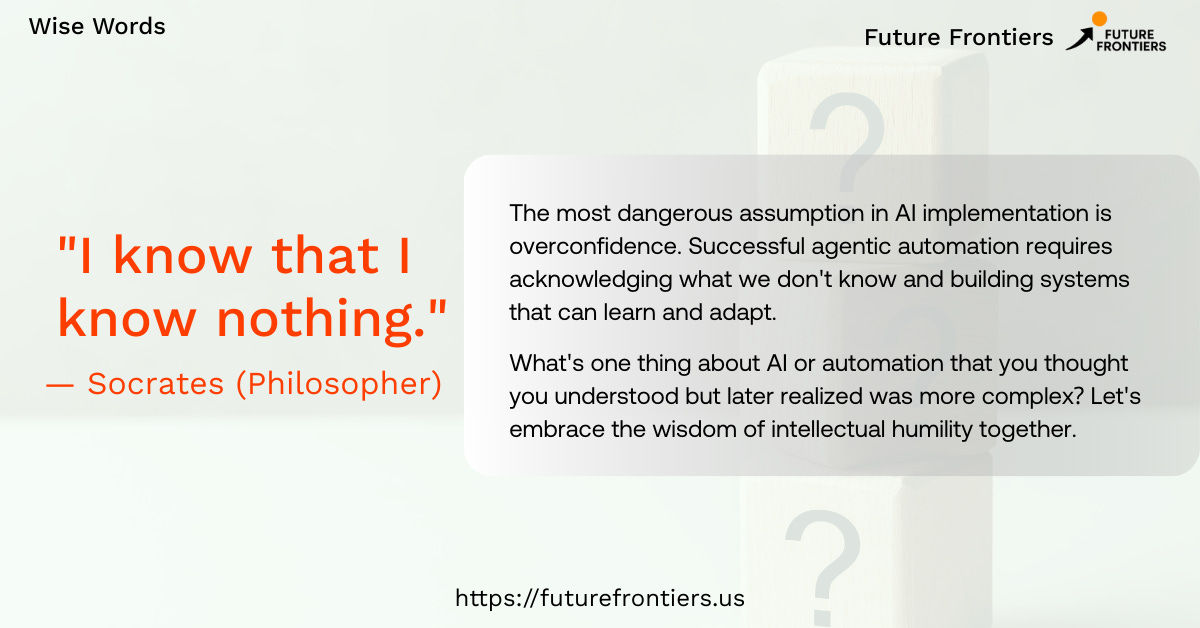
"I know that I know nothing."
— Socrates (Philosopher)
The most dangerous assumption in AI implementation is overconfidence. Successful agentic automation requires acknowledging what we don't know and building systems that can learn and adapt.
Quizzical :
Process Discovery and Task Intelligence
Question 1: What is process mining primarily used for?
a) Extracting minerals from data
b) Discovering, monitoring, and improving real business processes
c) Mining cryptocurrency
d) Database optimization
Question 2: Which data source is most valuable for task mining?
a) Financial reports
b) User interface interactions and system logs
c) Employee surveys
d) Market research
Question 3: What's the difference between process mining and traditional business analysis?
a) Process mining uses actual system data rather than interviews and workshops
b) Process mining is cheaper
c) Traditional analysis is more accurate
d) There is no difference
Question 4: What can task mining reveal that surveys cannot?
a) Employee satisfaction
b) Actual work patterns versus perceived patterns
c) Future market trends
d) Customer preferences
Question 5: What's the primary output of process intelligence?
a) Cost savings reports
b) Visual process maps and performance insights
c) Employee rankings
d) Technology recommendations
Poll :
Skills for the AI Era
Just In Jest :
RPA Reality Check
Our RPA bot is so proficient at filling out forms that it applied for its own promotion. And got it.
This article comes at the perfect time. 'Every action becomes data' – so genuis.