
Future Frontiers - Issue 8
In this issue:
Focus Feature: The Invisible Enterprise
Free Resource: The Hidden Work Assessment
Demystifying AI: Natural Language Processing (NLP)
Leadership Lessons: AI Agent Frameworks
Wise Words: Albert Einstein
Brain Teaser : The Data Ownership And Insights Dilemma
Quizzical : Organizational Change and AI
Just In Jest :
Focus Feature:
The Invisible Enterprise: Mapping the Shadow Operations That Really Run Your Business
The boardroom presentation is flawless. Colorful process maps flow across the screen, showing how work moves through the organization with mathematical precision. Every step is documented, every handoff is transparent, and every decision point is mapped. The executives nod approvingly at this picture of operational excellence.
But in the cubicles three floors down, Sarah from accounts payable is crafting her daily workaround to a procurement system that technically should handle everything she needs but somehow never does. Down the hall, Marcus has developed a personal relationship with someone in legal who can fast-track contract reviews in ways that would horrify the compliance team if they knew. And in the customer service center, the entire afternoon shift has collectively abandoned the official troubleshooting script in favor of an approach that actually resolves issues on the first call.
Free Resource :
The Hidden Work Assessment
Every organization has two operating systems: the one on paper and the one that actually gets things done. The gap between these systems represents both your biggest risks and your greatest opportunities.
Demystifying AI:
Natural Language Processing (NLP)
Natural Language Processing, or NLP, is the foundational technology that enables machines to understand, interpret, and generate human language. In essence, it acts as a translator between the fluid, often ambiguous way humans communicate and the precise, literal world of computer data. This is the core engine behind tools you already use daily; it powers the conversational intelligence of ChatGPT, parses your email requests to schedule a meeting, and allows you to ask Siri or Alexa a question in plain English instead of a specific computer command. It moves us beyond the era of rigid, keyword-based searches and into one of intuitive, context-aware interaction.
Leadership Lessons:
AI Agent Frameworks
As AI models (especially LLMs) become more powerful, a critical challenge has emerged: how to effectively connect them to external data sources, software tools, and systems. Pure LLMs are limited by their internal knowledge and lack the ability to perform actions in the real world.
Frameworks like MCP (Model Context Protocol), A2A (Agent-to-Agent), and others provide standardized methods to bridge this gap. They define protocols for servers (which provide tools and data) to communicate with clients (like an AI assistant or agent), enabling the AI to perform tasks such as reading files, querying databases, executing code, and even delegating work to other agents.
Wise Words:
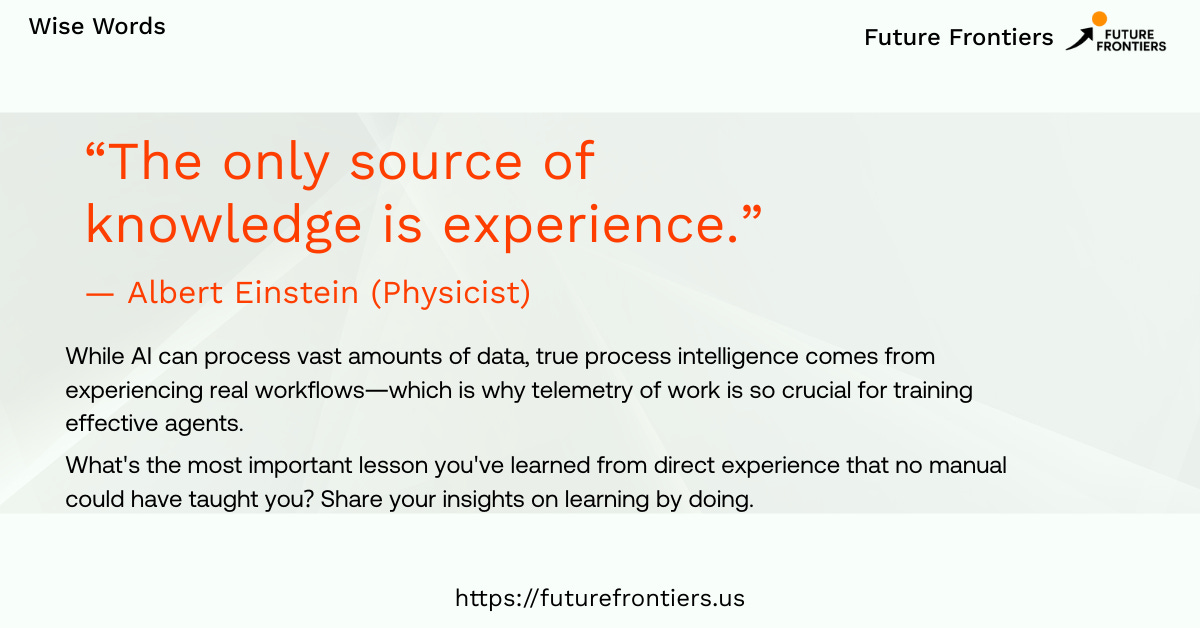
"The only source of knowledge is experience."
— Albert Einstein (Physicist)
While AI can process vast amounts of data, true process intelligence comes from experiencing real workflows—which is why telemetry of work is so crucial for training effective agents.
What's the most important lesson you've learned from direct experience that no manual could have taught you? Share your insights on learning by doing.
Brain Teaser :
The Data Ownership And Insights Dilemma
Three departments share data through an AI platform:
Marketing contributes 40% of the data, wants 50% of the insights
Sales contributes 35% of the data, wants 40% of the insights
Operations contributes 25% of the data, wants 30% of the insights
Each department's requests total 120% of available insights. How should the AI system fairly allocate insights to minimize dissatisfaction?
Quizzical :
Organizational Change and AI
Question 1: What percentage of employees typically embrace new technology immediately?
a) 50-60%
b) 30-40%
c) 15-25%
d) 5-10%
Question 2: What's the most effective change management strategy for AI adoption?
a) Surprise implementations to avoid resistance
b) Inclusive planning with affected stakeholders
c) Executive mandates without explanation
d) Gradual secret rollouts
Question 3: How should organizations address job displacement concerns?
a) Ignore them until after implementation
b) Promise no jobs will be affected
c) Provide transparent communication and reskilling opportunities
d) Implement AI without telling employees
Question 4: What role should middle management play in AI transformation?
a) Passive observers
b) Change champions and process experts
c) Obstacles to overcome
d) Technical implementers
Question 5: What's the most important cultural shift for AI success?
a) Technical expertise in every role
b) Embracing experimentation and continuous learning
c) Eliminating all manual processes
d) Centralized decision-making
Just In Jest :
Workday Blues
Workday Blues: My first-party data revealed that I spend 73% of my workday looking busy while actually reading newsletters about the future of work. Meta.