
Focus Feature: The Great Unbundling
The Great Unbundling: When Every Process Becomes a Service
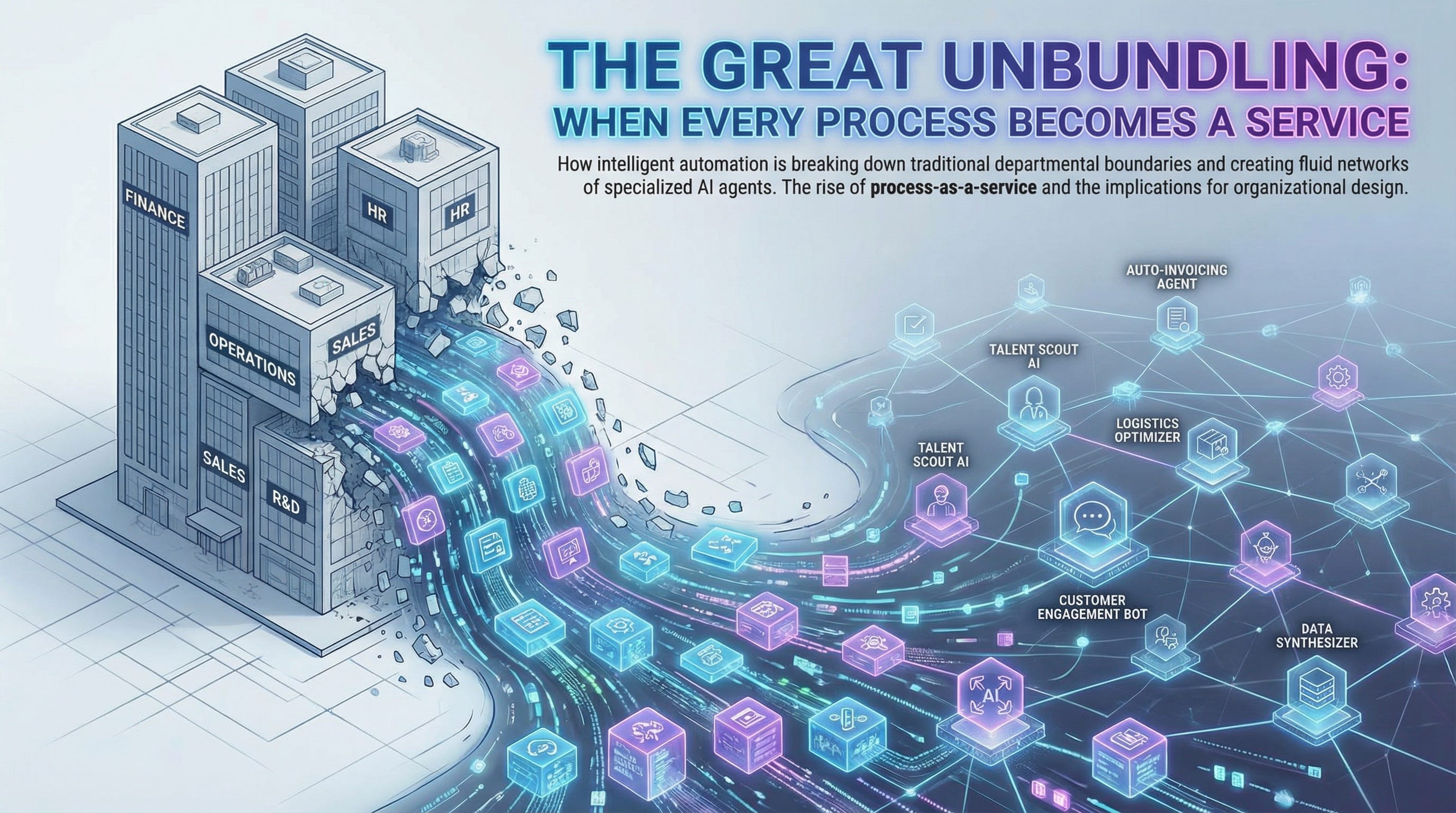
As a founder of a company that began by mapping how work actually gets done, through observing keystrokes, application usage, and the digital breadcrumbs of daily operations, I’ve had a front-row seat to a profound shift. For years, we helped enterprises visualize their workflows, revealing the messy, human-driven reality behind their pristine process diagrams. Today, that observational foundation is leading us to a place even more transformative: a world where enterprise processes are no longer confined to departmental silos or static playbooks, but are dynamically delivered as services by networks of intelligent agents. We are entering the era of The Great Unbundling.
This isn’t just another incremental step in automation. It’s a fundamental architectural shift in how enterprises function. Think of it as the transition from monolithic mainframe applications to microservices, but applied to the very work of the company. The unit of value is no longer a department’s output or a software license, but a discrete, outcome-driven process—auditable, composable, and increasingly autonomous.
From Process Maps to Agentic Networks
Traditionally, process discovery was an exercise in documentation, often leading to rigid RPA scripts or lengthy transformation projects. The process was seen as a fixed asset to be optimized. Our observational data, however, consistently showed something different: processes are fluid, context-dependent, and riddled with exceptions. The “real” process was a shadow version of the official one, held together by tribal knowledge and heroic manual effort.
The breakthrough of Agentic AI is that it doesn’t require a perfect, static map. Instead, it allows us to imbue software with the goal-oriented flexibility and contextual understanding to navigate this complexity. We’re moving from automating tasks to automating judgment within bounded domains.
Consider the quintessential example: the employee onboarding process. Traditionally, it’s a handoff carnival between HR, IT, Facilities, and Finance. Tickets are created, emails fly, and things fall through the cracks. In an unbundled world, “Employee Onboarding” becomes a service. A supervising agent, acting as a conductor, decomposes a new hire request into sub-process services: Background Check Service, Laptop Provisioning Service, Account Creation Service, and Benefits Enrollment Service. A specialized agent, a combination of agents, or human-in-the-loop steps, could fulfill each of these.
Crucially, these agents aren’t hardwired to specific systems. A Vendor Invoice Processing Service agent, trained on thousands of invoices and procurement policies, can access the ERP, the email system, and the accounting software via APIs. It executes its function—validating, coding, and approving an invoice—not as a user of the finance department, but as a provider of the “Invoice-to-Pay” service to the procurement or operations “client.” The departmental boundary dissolves. The service level agreement (SLA) on accuracy and time becomes the primary metric, not the departmental headcount.
The Technical Pillars of Unbundling
This shift rests on three converging technical pillars:
First-Party Work Telemetry & Ambient Data: The fuel for this transformation is the detailed, observational data of how work is performed. This goes beyond task mining. It’s the rich context of decisions made, applications switched between, data copied from one field to another, and exceptions handled. This data trains agents to understand not just the “what” but the “why” of a process. According to a 2023 report by Everest Group, enterprises with mature process intelligence initiatives report 30-50% higher automation success rates, as they target the right processes with the right automation.
The Agentic AI Stack: This is the engine. It moves beyond single-model prompts to architectures that bring multiple AI models, tools, and reasoning loops together. A robust agentic stack features:
Orchestrator/Supervisor Agents: These break down high-level goals (e.g., “Resolve customer complaint #123”) into sub-tasks and assign them.
Specialist Agents: Fine-tuned or prompted for specific domains (contract review, data anomaly detection, technical support tier-1).
Tool-Use & API Integration: The agent’s ability to act in the digital world—logging into systems, querying databases, updating records.
Memory & Learning: The capacity to retain context within a workflow and improve over time based on outcomes.
API-First & Composable Infrastructure: The unbundled process-service must be able to plug and play. This requires an enterprise architecture where core capabilities—from checking inventory to calculating risk scores—are exposed as clean, well-documented APIs. The agent becomes just another consumer of these APIs. Gartner’s prediction that by 2026, 30% of new applications will be delivered as composable “packaged business capabilities” underscores this direction.
Implications for Organizational Design: The End of the Empire?
This is where the conversation moves from IT to the C-suite. If every process can be sourced as a service from an internal or external network of agents, what happens to the traditional organizational chart?
The functional empire, the large centralized department that “owns” a primary process end-to-end, becomes a coordinator of specialized service teams, both human and agentic. The focus of leadership shifts from managing headcount and budget for a function to curating, measuring, and continuously improving a portfolio of services.
We’ll see the rise of new roles:
Service Portfolio Managers: Who own the catalog of process-services, their SLAs, and their evolution.
Agent Trainers & Ethicists: Who fine-tune agent behavior and ensure alignment with corporate policy and regulatory requirements.
Human-A workflow Designers: Who architect the ideal handoffs between automated services and human expertise for complex judgment and empathy.
Resistance is inevitable. Unbundling threatens traditional power structures and budget allocations. A VP whose authority is tied to a large team executing a manual process will rightly see this as disruptive. The change management is not just about technology adoption but about redefining value and influence.
The Nuanced Reality: Challenges on the Path to Unbundling
This future is compelling, but it’s not a utopia. As we guide enterprises toward it, several critical challenges emerge:
The Orchestration Overhead: Creating a seamless network of agents is itself a complex process. Poorly designed orchestrators can create brittle, cascading failures. The “microservices malaise” of distributed systems, latency, tracing errors, and versioning hell will have a direct analogue in agentic networks.
Governance, Security, and the “Black Box”: When a network of AI agents executes a critical financial process, who is accountable? How do you audit a chain of reasoning across multiple models? Security becomes paramount; a compromised agent with broad API access could be catastrophic. Explainability is no longer a nice-to-have but a compliance necessity.
The Human Displacement & Upskilling Paradox: The goal is augmentation, not replacement, but the transition will be uneven. The unbundling of processes will unbundle jobs. The critical task for leaders is to reskill talent toward higher-value work, manage exceptions, train agents, and perform the complex, integrative tasks that agents cannot.
The Data Divide: This future is only available to data-rich enterprises. Our observational approach works because of the volume and quality of first-party work data. Organizations without mature digital footprints will struggle to train effective agents, potentially exacerbating competitive disparities.
A Balanced Path Forward: Implementation Orientation
For the senior technology leader looking to navigate this unbundling, here is a pragmatic, implementation-focused approach:
Start with Observation, Not Assumption: Use process intelligence tools to identify the true candidates for unbundling. Look for processes with high volume, clear rules, digital data inputs, and existing pain points. The “Procure-to-Pay” or “Lead-to-Cash” value chains are rich hunting grounds.
Design for Service, Not for Department: When architecting an automation, define its boundaries and interfaces as a service. What is its input? Its output? Its SLA? Its fallback procedure (the “human in the loop” escape hatch)? This mindset is as important as the technology choice.
Build the “Process Service Mesh”: Invest in the underlying platform that will allow your agents to communicate, be monitored, and be secured. This is your control plane for the unbundled enterprise. Think service mesh for AI agents.
Run Pilots in Hybrid Mode: Don’t attempt a “big bang” unbundling. Launch a process-as-a-service in parallel with the existing human-driven process. Compare outcomes, measure the agent’s success rate, and iterate on the handoffs. This builds confidence and generates the performance data needed to secure broader buy-in.
Reimagine KPIs and Structure in Tandem: Work with your HR and business line counterparts to begin aligning metrics and incentives around service outcomes rather than functional efficiency. Pilot new, flatter structures around key service portfolios.
The Great Unbundling is not an overnight event. It is a directional shift, powered by the convergence of deep process understanding and agentic AI. It promises an enterprise that is more fluid, resilient, and focused on value creation over bureaucratic management. The role of the technology leader is to be both architect and guide—building the technical foundations while steering the organization through the profound human and structural changes this unbundling will unleash. The goal is not a fully autonomous enterprise run by bots, but a profoundly augmented one, where a seamless network of intelligent process-services amplifies human creativity and strategic insight. The empire of the silo is fading; the network of services is rising. The question is not if your organization will be affected, but how deliberately you will shape its journey.