
Brain Teaser: The Multi-Agent Resource Allocation
A process automation platform manages server resources across three environments:
Production: Needs 60% resources minimum, can use up to 80%
Staging: Needs 15% minimum, can use up to 40%
Development: Needs 10% minimum, can use up to 30%
During peak load, Production demands 85%, Staging needs 25%, and Development requests 20% (total: 130% of available resources). What’s the optimal allocation strategy that satisfies minimum requirements while being fairest to actual needs?
Answer:
There are several ways one can do it. Here is the optimal allocation strategy
Optimal Allocation (Max-Min Fairness)
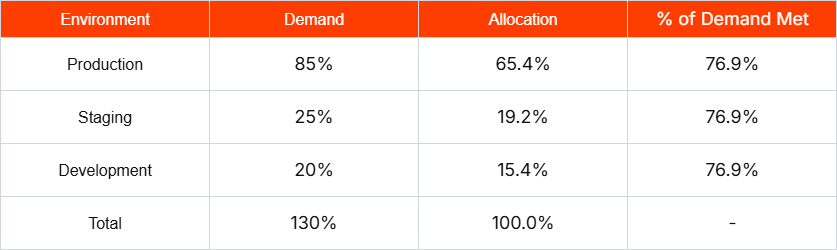
How?
Step 1: Recognize total demand (130%) exceeds capacity (100%).
Step 2: Apply proportional scaling (max-min fairness) to treat all demands equally:
Production: 65.4%
Staging: 19.2%
Development: 15.4%
Step 3: Verify hard constraints:
Production 65.4% ≥ 60% min and ≤ 80% max ✓
Staging 19.2% ≥ 15% min and ≤ 40% max ✓
Development 15.4% ≥ 10% min and ≤ 30% max ✓
Why This Is Fairest
This is the max-min fair solution: it maximizes the minimum percentage of demand satisfied across all environments (76.9% each).
Alternative strategies (like strict business priority) would allocate Production 75%, Staging 15%, Dev 10% (Production gets 88% of its needs met, but Development only gets 50%). The proportional approach ensures no environment suffers disproportionately—all bear the same 23.1% shortfall relative to their actual needs.