
Focus Feature: The Silent Degradation
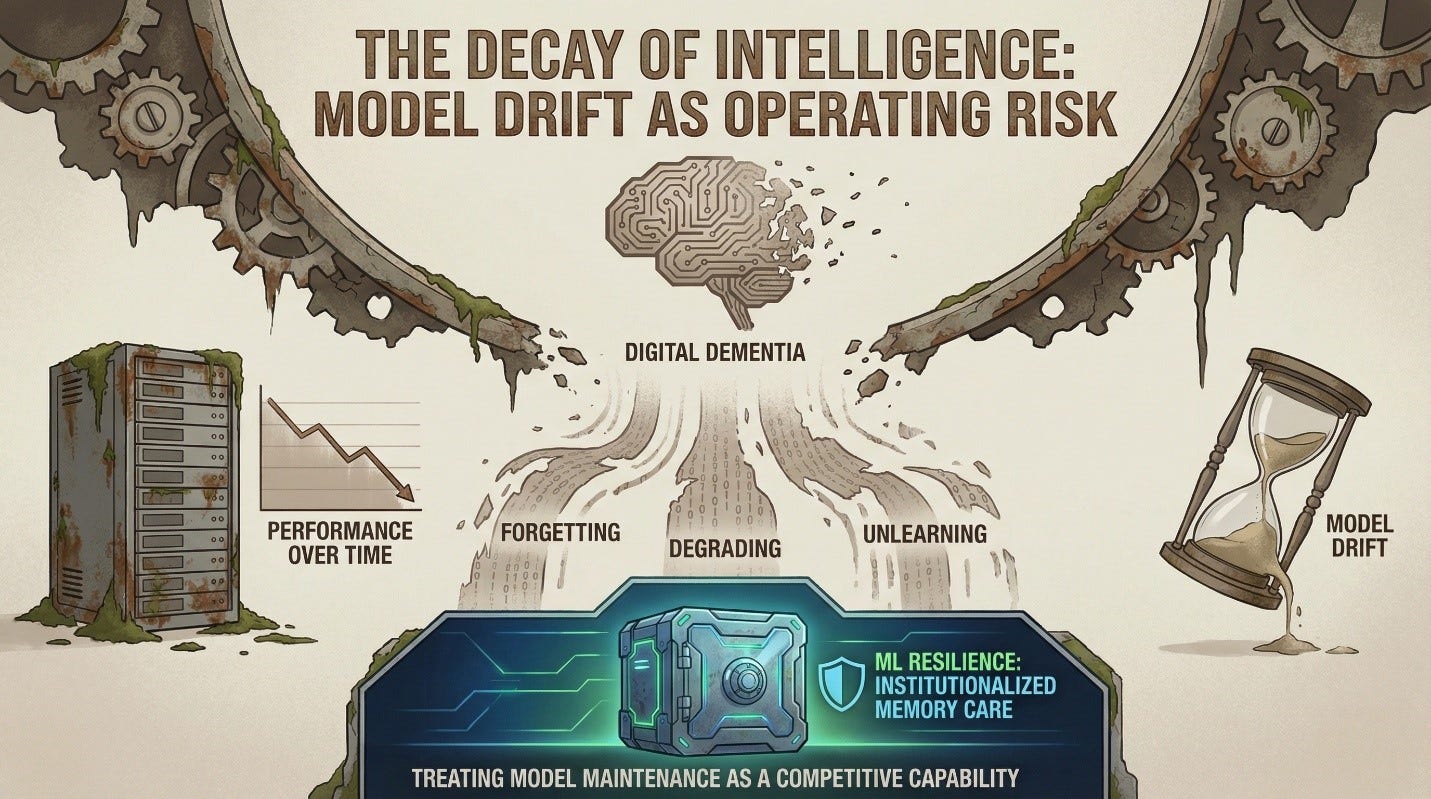
The artificial brain does not announce its aging. It does not flash error messages or trigger graceful failovers. It simply forgets, quietly, incrementally, and often invisibly. Research from Harvard, MIT, and the University of Monterrey confirms what operations teams have long suspected: 91% of machine learning models degrade in production. Not fail catastrophically, but fade, like a photograph left in direct sunlight, its clarity dissolving while the frame remains intact.
This phenomenon, variously termed model drift, temporal degradation, or, with growing frequency, AI aging, represents one of the most insidious operational risks in modern enterprise technology. Unlike traditional software that performs deterministically until it breaks, AI systems exhibit a peculiar form of “digital dementia.” They continue functioning while progressively losing touch with reality, their predictions becoming less tethered to actual outcomes until business value hemorrhages, not through system crashes, but through the slow erosion of decision quality.
The Anatomy of Forgetting
To understand why intelligence decays, we must distinguish between the maladies afflicting production models. Model decay resembles acute trauma: a sudden, persistent drop in performance caused by broken data pipelines, missing signals, or infrastructure failures. It is the cognitive equivalent of a stroke—immediate, noticeable, and demanding urgent intervention.
Model drift, conversely, mimics neurodegenerative disease. It is the gradual shift in statistical properties between training data and production reality. A credit risk model deployed in January 2024 might boast 95% accuracy in identifying loan defaults. By September, without any code changes or system errors, that accuracy can plummet to 87%, not because the model broke, but because the world changed. Inflation shifted borrowing behaviors, new customer demographics emerged, and fraud vectors evolved, rendering the model’s learned associations obsolete.
The taxonomy of drift reveals three distinct types:
Data drift occurs when input distributions shift, when the “ingredients” no longer match the recipe the model learned from.
Concept drift represents a deeper crisis: the fundamental relationship between inputs and outputs transforms. A spam filter trained in 2022 faces evolved linguistic tactics in 2025; the very definition of “spam” has mutated.
Prediction drift manifests when output distributions change despite static inputs, suggesting the model has wandered outside its training distribution, attempting to price laptop bundles at $8,000 when it was trained on $500-$3,000 ranges.
The Reality
The deterioration is neither hypothetical nor benign. In financial services, unchecked model drift threatens existential consequences. Research indicates that undetected drift could increase default rates by 8% to 20% in exposed sectors, while regulatory fines for inadequate model governance may exceed $500 million annually for major institutions.
When algorithmic decision-making produces unfair loan denials or inaccurate risk assessments, reputational contagion spreads rapidly, eroding trust and driving customer attrition to competitors.
The operational statistics are equally stark. Nearly 90% of machine learning models never reach production, held back by inadequate monitoring architectures and the misconception that deployment equals completion. Among those that do survive the launch gauntlet, the majority suffer from “training-serving skew”, the divergence between laboratory performance and production reality that manifests as silent accuracy hemorrhage.
Consider the fraud detection model protecting millions of transactions daily. Without real-time monitoring that can detect when 25th-percentile prediction confidence drops significantly (signaling the model is becoming less confident about its own decisions), organizations operate blind—defending against yesterday’s fraud techniques while tomorrow’s evolve undetected.
Institutionalizing “Memory Care”
The emerging discipline of ML resilience reframes model maintenance from an IT hygiene task into a competitive capability that requires systematic “memory care.” This approach recognizes that production AI systems are not static artifacts but living cognitive infrastructures requiring continuous neurological rehabilitation.
Memory care in this context involves three institutional protocols:
First, continuous vitals monitoring. Rather than quarterly model reviews, resilient organizations implement layered detection systems that combine performance metrics (accuracy, precision, recall), distribution analysis (Population Stability Index thresholds that trigger investigation at PSI > 0.1 and alerts at PSI > 0.25), and prediction distribution tracking. These systems function like cognitive vital signs, catching degradation before business outcomes deteriorate.
Second, automated rehabilitation pipelines. When drift is detected, resilient systems trigger retraining workflows—not as emergency surgery, but as routine physical therapy. The most sophisticated organizations have shifted from time-based retraining (every quarter) to performance-based retraining (when degradation exceeds thresholds of 1-3%), ensuring models adapt to evolving patterns rather than reacting to crises.
Third, cognitive lineage preservation. Unlike traditional software versioning, ML resilience requires tracking not just code changes but data provenance, feature transformations, and decision boundaries. When a model’s performance degrades, forensic analysis must reconstruct not merely what changed in the code, but how the statistical relationship between variables evolved—requiring explainability architectures that illuminate the “digital dementia” at the feature level.
From Hygiene to Strategy
Organizations that treat model maintenance as IT hygiene, necessary but unglamorous, consign themselves to competitive disadvantage. The alternative is institutionalizing ML resilience as a core organizational capability, embedding “memory care” into the operational DNA.
This transformation requires cultural shifts as much as technical architectures. Data scientists must transition from “model developers” to “cognitive caretakers,” responsible for the longitudinal health of models rather than initial accuracy metrics. Business stakeholders must internalize that model deployment initiates a lifecycle of care, not a project conclusion. Compliance and risk functions must evolve to monitor algorithmic vital signs with the same rigor applied to financial audits.
The economic calculus is compelling. Preventing an 8-percentage-point drop in accuracy in a credit risk model preserves not just regulatory standing but also substantive revenue. Avoiding the $500 million annual fines threatened by emerging model governance regulations represents direct value preservation. More strategically, organizations that master ML resilience gain velocity advantages, deploying models with confidence that their performance will be maintained, rather than deploying with hope and monitoring with anxiety.
The Decay Imperative
As AI systems permeate high-stakes domains—from diagnostic medicine to algorithmic trading, from autonomous logistics to credit adjudication—the decay of intelligence is no longer a technical footnote. It becomes an operating risk of existential magnitude. The 91% degradation rate is not a statistical anomaly; it is an emergent property of deploying static learning systems in dynamic environments.
The organizations that thrive will be those that institutionalize memory care not as a cost center but as a competitive moat. They will treat model drift with the same clinical seriousness as financial audit or cybersecurity, recognizing that, in the cognitive economy, maintaining intelligence is as valuable as creating it. The alternative, allowing the artificial brain to quietly forget, to develop digital dementia while the business depends on its judgment, is a risk no modern enterprise can afford to ignore.