
Focus Feature: The Trust Deficit
The Trust Deficit: Why AI Governance Is the New Foundation
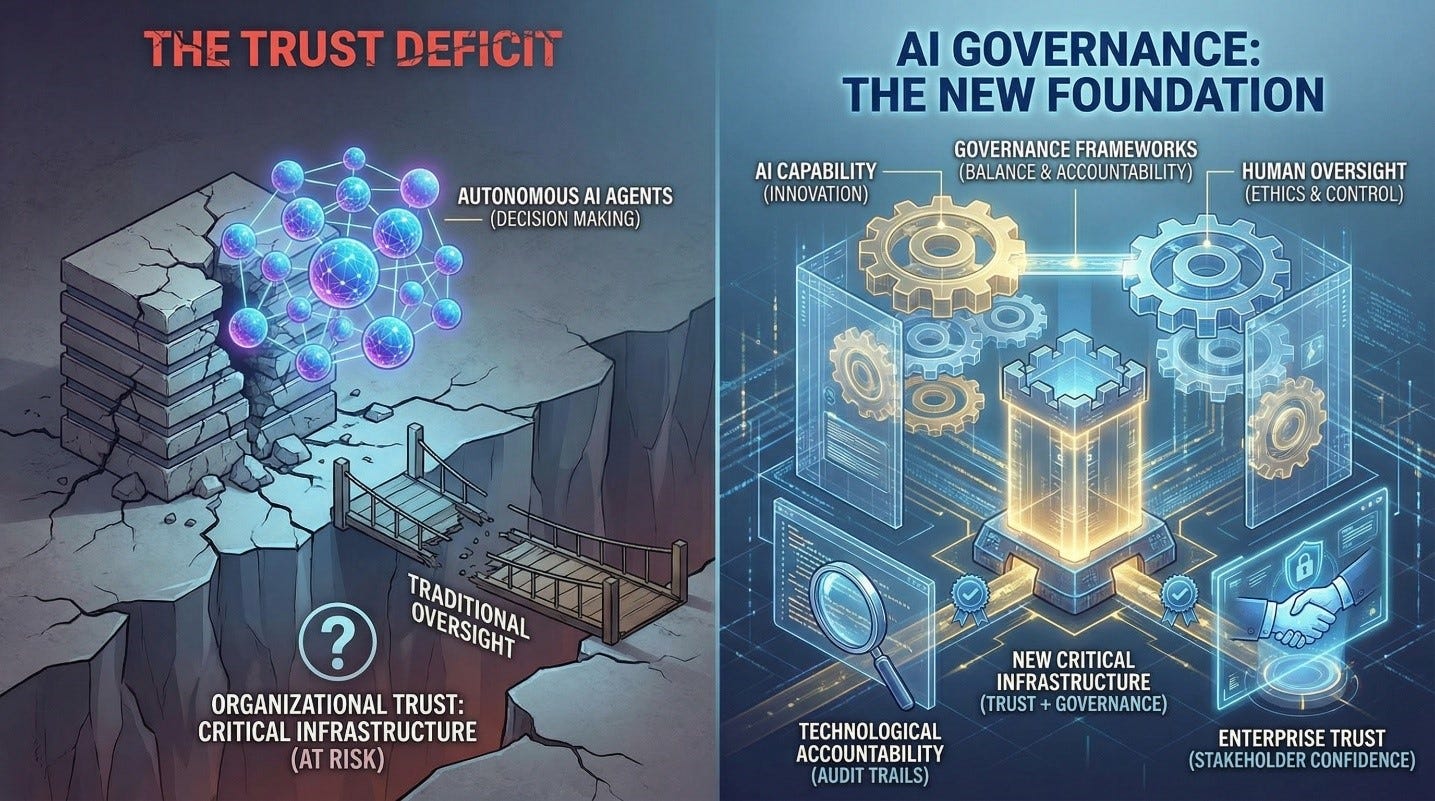
The gleaming promise of artificial intelligence has collided with an uncomfortable reality: organizations are deploying systems they don’t fully understand, can’t adequately explain, and struggle to control. As AI agents make increasingly autonomous decisions, approving loans, filtering job candidates, pricing products, and diagnosing diseases, the trust deficit has become the defining challenge of enterprise technology in 2026.
This isn’t theoretical anymore. Nearly half of Fortune 100 companies now specifically cite AI risk as part of board oversight, a threefold increase from just one year ago. Yet the statistics reveal a troubling gap: only 11% of boards have approved annual budgets for AI projects, and a mere 23% have assessed how AI disruption might fundamentally reshape their business models. The gap between AI adoption and AI governance has never been broader or more consequential.
The Acceleration Without Guardrails
The numbers tell a story of breakneck adoption outpacing organizational readiness. Worker access to AI has expanded by 50% in a single year, growing from fewer than 40% to around 60% of employees now equipped with sanctioned AI tools. Among companies surveyed by Deloitte, 25% expect to move at least 40% of their AI experiments into production within the next three to six months.
Yet governance frameworks lag dangerously behind. Just 43% of surveyed organizations have an AI governance policy in place, with another 25% still in the process of implementing one. Perhaps most alarming: 29% of organizations have no AI governance policy whatsoever. This creates what experts call “accountability gaps”, situations where algorithms make consequential decisions, but there is no transparent chain of responsibility to explain, override, or rectify them.
The consequences of this governance deficit are already visible. The AI Incidents Database recorded 233 reported AI-related incidents in 2024, a 56.4% increase over the previous year. These aren’t abstract failures; they’re discrimination lawsuits, privacy violations, and systems that systematically disadvantage vulnerable populations.
When Algorithms Discriminate
A few cases illuminate the stakes. SafeRent Solutions agreed to pay $2.2 million to settle a class action lawsuit alleging that its AI tenant-screening algorithm discriminated against Black renters and those using housing vouchers. Apple’s credit card offered women significantly lower credit limits than men with identical financial profiles, a pattern so blatant that Steve Wozniak publicly called it out when his wife received a limit ten times smaller than his, despite having better credit.
In healthcare, an AI screening tool systematically ranked resumes with disability-related credentials lower than identical resumes without them. In Italy, regulators temporarily banned ChatGPT after discovering OpenAI was collecting and processing personal data from conversations without proper consent, with no mechanism for users to opt out or delete their information.
These aren’t isolated glitches. They’re symptoms of a systemic problem: organizations deploying robust decision-making systems without the governance infrastructure to ensure those systems operate fairly, transparently, and accountably.
The Four Pillars of Technological Accountability
Effective AI governance rests on four foundational pillars, according to enterprise governance research. Strategic oversight ensures AI initiatives align with organizational values and business objectives. Capital allocation establishes disciplined investment processes, moving beyond experimental budgets to production-scale funding with clear ROI expectations. Risk management identifies and mitigates AI-specific threats, including model drift, bias amplification, data poisoning, and adversarial attacks. Technological competence builds the literacy boards, and executives need to ask informed questions and make sound decisions about systems they may never fully master.
The competence gap proves particularly challenging. Nearly 44% of Fortune 100 companies now mention AI in their descriptions of director qualifications, up from just 26% in 2024. Yet this attention hasn’t translated into systematic governance. The number of S&P 500 companies assigning AI oversight to board committees more than tripled in 2025, but most boards still lack formal AI governance frameworks or established metrics for management reporting.
From Principles to Practice
Leading organizations are translating abstract principles into concrete practices. They maintain comprehensive inventories of AI systems deployed across departments, conduct risk classifications distinguishing high-stakes applications from routine automation, establish clear accountability for each deployed model, and implement continuous monitoring rather than one-time assessments.
Documentation emerges as a critical discipline. Organizations that successfully navigate audits maintain comprehensive records of model design decisions, training data sources, validation results, and ongoing performance metrics. This documentation is essential when regulators or litigants demand explanations for algorithmic decisions—a demand that’s coming more frequently as the regulatory landscape tightens.
The NIST AI Risk Management Framework provides structure, organizing oversight into four functions: Govern, Map, Measure, and Manage. The ISO/IEC 42001 standard offers formal certification for organizations ready to validate their AI management systems. The EU AI Act, effective in phases through 2026, classifies AI systems by risk level and imposes stricter requirements on high-risk applications in healthcare, finance, and public safety.
The Human-in-the-Loop Imperative
As AI systems grow more autonomous, the nature of human oversight must evolve. Traditional approval processes become impractical when agents make thousands of micro-decisions daily. Governance models must define boundaries rather than approve individual choices, monitor behaviors rather than review transactions, and implement circuit breakers rather than constant supervision.
Yet about 91% of organizations acknowledge AI’s role in risk and compliance, and 53% are actively using or trialing it, a sharp rise from previous years. The challenge isn’t convincing leaders that oversight matters; it’s building governance systems that scale with AI capabilities.
Industry guidance increasingly emphasizes “human-in-the-loop” validation, in which reviewers sample AI-classified decisions to ensure that machine outputs remain explainable and defensible. In e-discovery, AI-powered review platforms promise efficiency gains but introduce new risks around accuracy and privilege protection. In cybersecurity, AI expands the attack surface through new data flows while simultaneously enabling more sophisticated defenses. This dual reality demands governance models that integrate security and AI oversight rather than treating them as separate functions.
The Cost of Getting It Wrong
The price of governance failure extends far beyond regulatory fines. Biased algorithms damage reputations and invite litigation. Security breaches through AI systems erode customer trust. Failed projects waste capital and diminish competitive position. Perhaps most concerning, poor governance creates organizational paralysis, with innovation stalling amid uncertainty.
An MIT study reported that, despite $30 to $40 billion in enterprise investment in AI, 95% of organizations are seeing no measurable return. While the methodology behind this finding remains debatable, it highlights a deeper truth: without governance frameworks that enable controlled experimentation, rapid iteration, and accountable deployment, AI investments cannot deliver sustainable value.
Companies deploying AI for document review, threat detection, or compliance monitoring now face questions about data lineage, model explainability, and accountability that traditional governance frameworks were never designed to address. When an AI system misclassifies privileged documents or generates biased risk assessments, determining responsibility becomes a legal and operational quagmire.
Building Trust as Infrastructure
The organizations succeeding in 2026 treat trust not as a communications challenge but as technical infrastructure. They implement granular access controls that precisely define who can view, edit, or deploy AI applications. They maintain detailed audit logs, creating a trail that shows who made what change and when. They deploy hybrid architectures, keeping sensitive data on-premises while leveraging cloud-scale AI capabilities. They build permission-aware AI systems that respect existing data access policies rather than creating backdoors around security controls.
These practices transform AI from an uncontrolled risk into a managed capability that boards can confidently support. Successful governance doesn’t prevent all AI failures—the technology’s rapid evolution guarantees unexpected challenges. Instead, good governance ensures transparency when problems arise, the ability to adapt quickly, and accountability that maintains stakeholder trust even during setbacks.
The Window Is Closing
The governance imperative will only intensify as 2026 progresses. More jurisdictions will implement AI regulations. Investors will demand greater transparency. Cyber threats will grow more sophisticated. Agentic AI, systems operating with minimal human intervention, is expected to become nearly ubiquitous, with 74% of companies using it at least moderately within two years. Yet only 21% of companies currently report having a mature model for governance of autonomous agents.
The question facing organizations isn’t whether to govern AI; regulators, investors, and market forces have already decided that. The question is whether governance will be designed intentionally, with clear accountability and robust controls, or whether it will emerge reactively from crises, penalties, and failures.
Trust has become the critical infrastructure of the AI age. Organizations that recognize this reality and build governance frameworks equal to the challenge will unlock AI’s transformative potential. Those who don’t will find themselves explaining failures they should have prevented, defending decisions they can’t justify, and losing ground to competitors who understand that, in the age of autonomous systems, accountability isn’t a constraint on innovation; it’s the foundation that makes innovation possible.