
Focus Feature: The Work Telemetry Flywheel
The Work Telemetry Flywheel: How Smart Enterprises Turn Work into AI-Powered Advantage
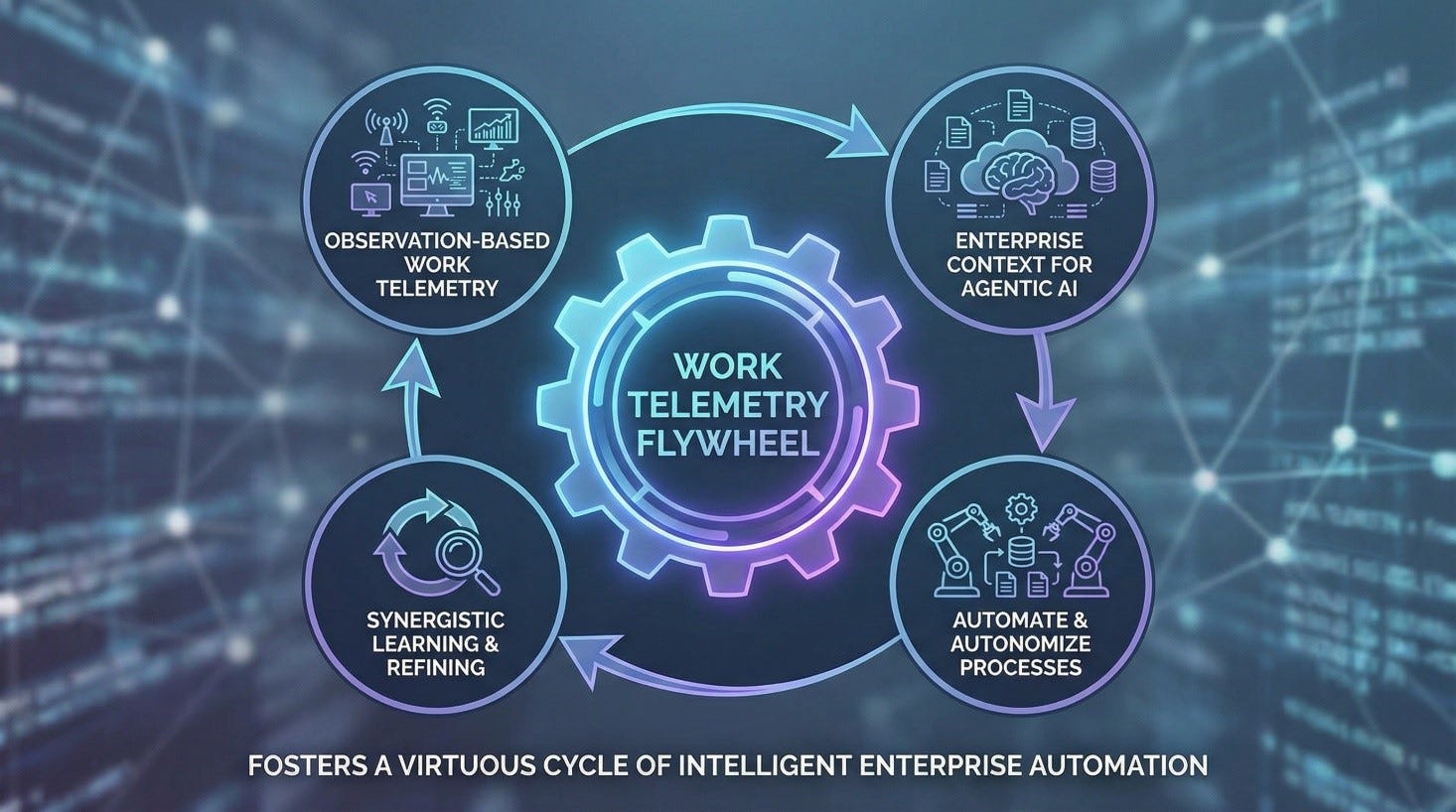
As we all realize, we’re standing at the edge of a new industrial revolution—but this time, it’s not about steam, steel, or silicon. It’s about data-driven autonomy. For decades, enterprises have chased efficiency through better tools, leaner processes, and smarter teams. Yet a critical piece has been missing: a real-time, holistic understanding of how work actually happens.
Enter Work Telemetry, the continuous, observational data emitted by digital work, and the Telemetry Flywheel, a compounding system that turns this data into autonomous intelligence and lasting competitive advantage. (Full Disclosure: The company, Skan.ai, which I co-founded, has pioneered observation-led work telemetry and process intelligence, and is now transitioning into enterprise automation and autonomy with Agentic AI.)
This isn’t about tracking hours or monitoring clicks. It’s about creating a living map of your enterprise’s nervous system, so that AI agents can learn, adapt, and eventually automate the very workflows that define your business.
Let’s explore how leading organizations are building this flywheel, and why it’s becoming the core engine of the autonomous enterprise.
What is Work Telemetry? Beyond Metrics, Into Context
Most companies already collect data: sales numbers, support tickets, and project timelines. But this is output data, telling you what happened, not how it happened.
Work telemetry is first-party observational data captured passively from digital tools and interactions. It logs:
How decisions are made in a Slack thread or Teams channel
Which documents are referenced during a client proposal process
Where bottlenecks form in a software deployment pipeline
How experts navigate internal systems to solve problems
Which approval loops delay procurement or hiring
This is rich, contextual, behavioral data—the “dark matter” of organizational intelligence. It’s the difference between seeing a completed puzzle and watching someone assemble it, noting every rotation and connection.
And this context is precisely what Agentic AI requires to move from scripted automation to adaptive autonomy.
The Anatomy of the Telemetry Flywheel
The flywheel is a closed-loop system with five interdependent stages. Once set in motion, each rotation enriches the data, improves the AI agents, and compounds the organization’s advantage.
1. Observe: Capturing the Digital Exhaust
Everything begins with observation. This means instrumenting your digital workplace—project tools, communication platforms, CRM, ERP, code repositories, and even email—to capture work in motion passively. The goal is breadth and depth without intrusion.
Key principles:
Passive collection: No extra clicks, no manual logging. The data should be a byproduct of work, not an additional task.
Context preservation: Capture sequences, relationships, and environments, not just isolated events.
Privacy-by-design: Anonymize or aggregate sensitive data, focus on patterns rather than personal identifiers.
Example: A financial services firm instruments its underwriting workflow, observing how analysts cross-reference regulations, risk models, and client history before making a decision. They’re not judging performance; they’re mapping the process’s DNA.
2. Map Processes: From Chaos to Clarify
Raw telemetry is noise. The mapping stage turns it into a signal—a dynamic, living model of how work really flows.
Using process mining and task analytics, organizations can visualize:
The most common paths to complete a given outcome
Variations and exceptions that standard SOPs don’t capture
Unseen dependencies between teams or tools
Friction points where work stalls or escalates
This isn’t a static flowchart from a consultant’s deck. It’s a real-time, data-generated map that updates as behaviors evolve.
Example: A retail company maps its inventory replenishment process and discovers that store managers routinely bypass the official system to call warehouse contacts directly during shortages—a workaround born of necessity, now visible and understandable.
3. Analyze: Discovering the Levers of Advantage
With a living map in place, analytics uncovers opportunities. This goes beyond identifying bottlenecks; it’s about understanding why they exist and which interventions will have the highest return.
Sophisticated analysis might reveal:
Which steps in a process are prime for automation versus those requiring human judgment
How top performers differ in their work patterns from the median
Which micro-decisions have an outsized impact on outcomes like customer satisfaction or cycle time
How processes degrade under scale or stress
Example: A software company analyzes its sprint planning telemetry and finds that teams that spend more time collaboratively breaking down tickets before assigning them have 40% fewer mid-sprint blockers. The insight isn’t “work faster,” it’s “invest differently in clarification.”
4. Optimize & Automate: Deploying Agentic AI
Here’s where telemetry meets action. Insights from analysis fuel two types of intervention:
Optimization: Redesigning workflows, reallocating resources, or retraining teams based on empirical evidence. This is human-led change informed by data.
Automation (and Autonomization): Deploying AI agents to execute tasks, make contextual decisions, or even manage entire workflows autonomously.
Critically, these agents are trained and contextualized by your telemetry. They’re not generic chatbots; they’re role-specific, process-aware digital workers who understand your business’s unique rhythms, rules, and exceptions because they’ve “observed” how your people work.
Example: An insurance company uses telemetry from claims processing to train an AI agent that can autonomously handle routine, low-complexity claims, mimicking the exact steps, validations, and system interactions of their best human processors, while escalating only the atypical cases.
5. Govern: Steering with Confidence
As autonomy increases, governance ensures the flywheel turns safely and ethically. This stage sets guardrails, monitors outcomes, and provides continuous alignment with business goals and values.
Effective governance in a telemetry-powered environment includes:
Agent oversight: Tracking AI agent decisions, especially overrides or escalations.
Feedback loops: Capturing human corrections or approvals to retrain and improve agents.
Compliance & ethics audits: Ensuring decisions are fair, transparent, and compliant.
Performance monitoring: Measuring the impact of automation on outcomes like quality, speed, cost, and employee experience.
Governance isn’t a brake—it’s a steering mechanism. It allows the organization to accelerate autonomy with confidence.
The Compounding Engine: Why the Flywheel Accelerates
The magic isn’t in any single stage—it’s in the loop. Each rotation of the flywheel:
Enriches the data: Every automated process generates new telemetry, which is fed back into observation. The data gets richer, more representative, and more nuanced.
Improves the agents: AI agents learn from human feedback, success/failure signals, and evolving work patterns. They become more capable, context-aware, and trustworthy.
Compounds advantage: Efficiency gains free up human capacity for higher-value work. Employees shift from doing repetitive tasks to overseeing and improving systems, which in turn generates smarter telemetry and better automation.
This creates a virtuous cycle: better data → better insights → better automation → better outcomes → even better data.
Building Your Flywheel: Practical First Steps
Starting a telemetry flywheel doesn’t require a “big bang” transformation. It begins with focus and iteration.
Pick one high-value, observable process. Start with a contained workflow with clear boundaries and measurable outcomes, like invoice processing, IT ticket routing, or content approval. Avoid mission-critical or overly complex processes for your pilot.
Instrument tactfully. Deploy lightweight, non-intrusive observation in the tools already used for that process. Communicate the “why” clearly to teams: this is about improving the work, not monitoring people.
Map and analyze before automating. Spend time understanding the current-state reality. Look for the gaps between the official process and the real one. Identify the “easy win” bottlenecks and the steps that truly require human nuance.
Start with assistive, not autonomous, agents. Begin with AI copilots that suggest next steps, retrieve relevant information, or pre-fill forms. Build trust and learn from interactions before moving to full automation.
Close the loop with governance from day one. Establish clear metrics, review cycles, and escalation paths. Make a human ultimately accountable for the outcomes, even as agents take on more work.
The Human in the Loop: Empowerment, Not Replacement
A common fear is that work telemetry and agentic AI are intended to replace humans. In reality, the flywheel’s greatest potential is augmentation.
By offloading repetitive, low-context tasks to AI agents, employees can focus on the work that requires creativity, empathy, judgment, and strategic thinking. The flywheel doesn’t dehumanize work; it rehumanizes it, freeing people from the drudgery of bureaucratic process and enabling them to contribute their uniquely human strengths.
Moreover, employees become flywheel stewards: overseeing agents, handling exceptions, and continuously improving the system. Their role shifts from doer to designer, trainer, and orchestrator—more valuable and engaging work.
The Future Is Autonomizing
We are moving from the era of digital transformation (moving analog processes to digital tools) to autonomous transformation, where digitized processes become self-optimizing and self-operating.
The organizations that will lead this next decade are those that recognize work telemetry not as a surveillance tool, but as the foundational context for intelligence. They will build their flywheels not to cut costs, but to compound learning, accelerate innovation, and unlock human potential.
The telemetry flywheel turns work into data, data into insight, insight into action, and action into better work. It’s a compounding engine for the autonomous enterprise, and it’s already starting to spin.
The question is no longer whether to build it, but where to start.