
Future Frontiers - Issue 3
In this issue:
Focus Feature: Building Self-Healing Automation Systems
Free Resource: What Your Board Wants from AI in the Next 12 Months
Data Drop: LLMs and LAMs - A Capability Compariso
Demystifying AI: Telemetry of Work – What It Really Means
Leadership Lessons: Lin-Manuel Miranda's Democratic Creativity
Wise Words: Douglas Adams
Brain Teaser: The Process Automation Race
Quizzical: Digital Transformation Reality Check
Just In Jest
Focus Feature:
Building Self-Healing Automation Systems
Your automation system is working perfectly. The dashboards glow green. Performance metrics stay within acceptable ranges. Yet somehow, effectiveness is quietly eroding.
This is automation drift – the invisible degradation that happens when systems encounter the messy, ever-changing reality of business operations. It's not a dramatic failure. It's the slow disconnect between what your automation was designed to do and what your business actually needs it to do today.
Free Resource :
What Your Board Wants from AI in the Next 12 Months
A practical checklist for executives navigating boardroom expectations.
Most boardroom discussions about AI have a pattern. The conversation typically starts with excitement about possibilities, quickly moves to anxiety about risks, and often ends with a request for "something concrete we can measure."
Your board isn't asking you to become a data scientist overnight. They want assurance that you're thinking strategically about AI while managing the organization responsibly. This checklist reflects the questions I hear most often from directors and the deliverables that tend to satisfy their concerns.
Data Drop:
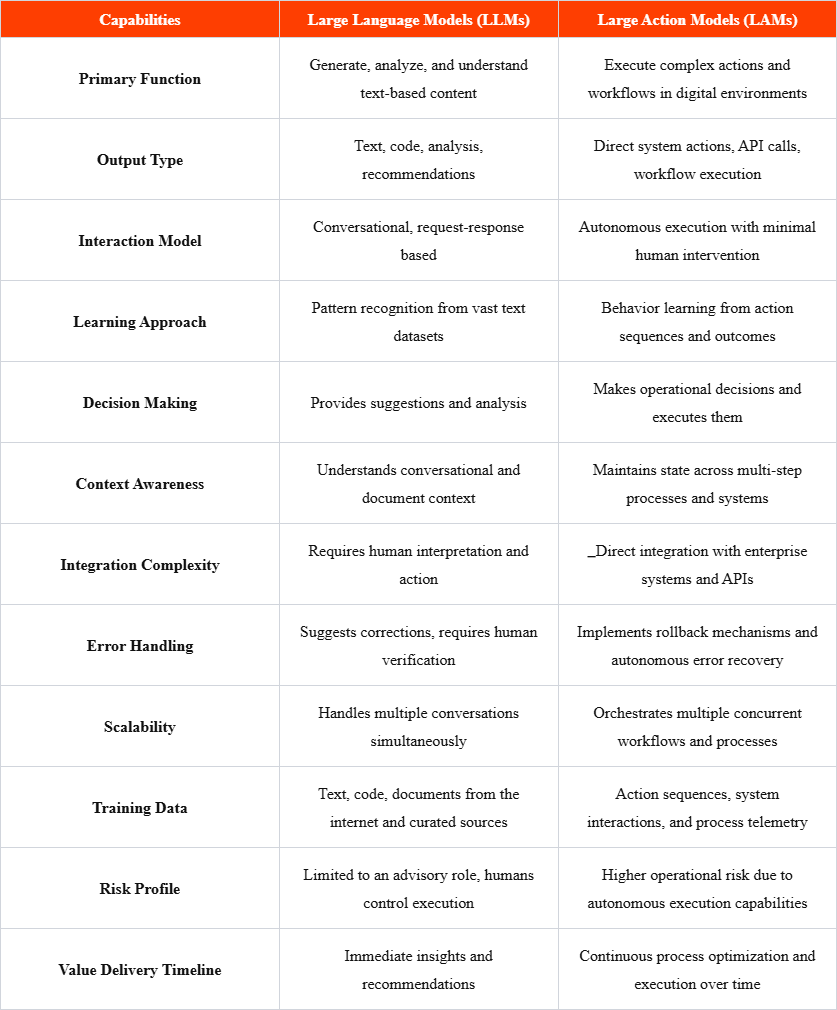
LLMs and LAMs - A Capability Compariso
The evolution from LLMs to LAMs represents a fundamental shift from "thinking" to "doing" in AI systems. While LLMs excel at understanding and generating content, LAMs bridge the critical gap between AI insights and real-world execution—the very gap that next-generation agentic AI platforms for enterprise process automation aim to bridge.
Think of it this way: If LLMs are like having a brilliant consultant who can analyze any situation and provide expert advice, LAMs are like having a skilled operations manager who not only understands what needs to be done but actually does it—with you keeping watch, of course
Demystifying AI:
Telemetry of Work – What It Really Means
Think of telemetry as your organization's digital nervous system. Just as telemetry in Formula 1 racing captures thousands of data points per second about engine performance, tire pressure, and driver behavior, "Telemetry of Work" captures the digital exhaust from how your employees actually get things done. Every click, keystroke, application switch, and process step generates data that reveals the true story of work—not how you think it happens, but how it really unfolds in practice.
Leadership Lessons:
Lin-Manuel Miranda's Democratic Creativity
I am sure many of you are fans of the historical musical – Hamilton. While creating Hamilton, Lin-Manuel Miranda didn't just write in isolation. He brought in collaborators early, held "Ham4Ham" videos with the cast, and continually refined the work based on feedback. His leadership style was remarkably inclusive—every voice mattered, from leads to ensemble.
Wise Words:
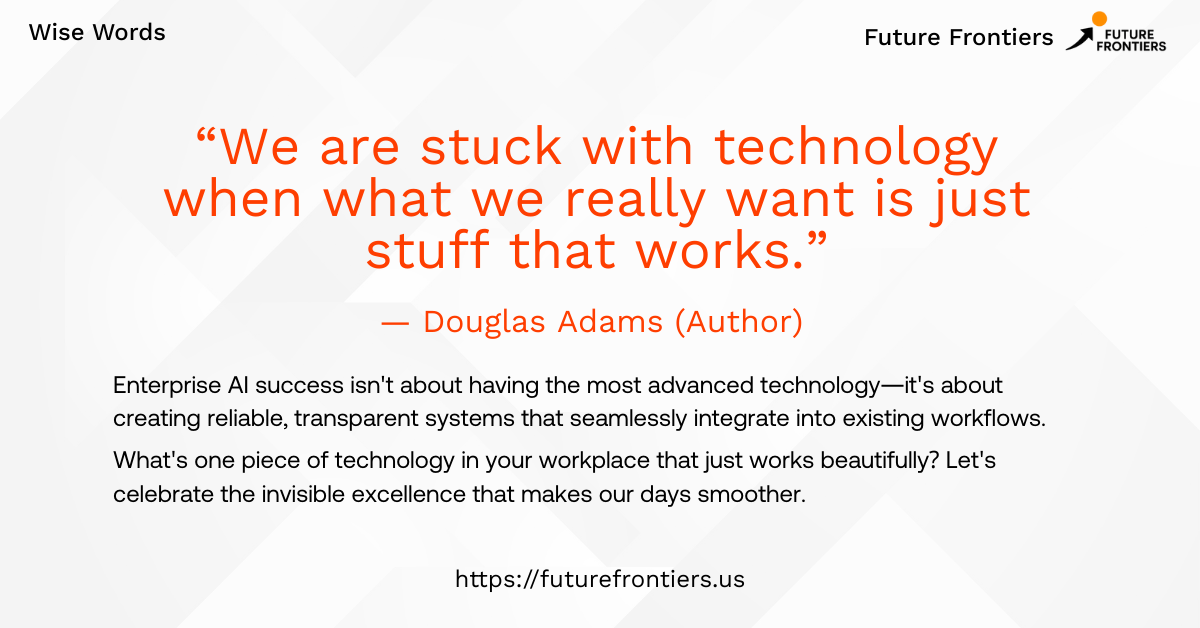
"We are stuck with technology when what we really want is just stuff that works."
— Douglas Adams (Author)
Enterprise AI success isn't about having the most advanced technology—it's about creating reliable, transparent systems that seamlessly integrate into existing workflows.
What's one piece of technology in your workplace that just works beautifully? Let's celebrate the invisible excellence that makes our days run more smoothly.
Brain Teaser :
The Process Automation Race
Two companies adopt process automation:
Company X waits for a "perfect" automation solution for 6 months, then implements perfect automation that reduces task time by 90%
Company Y implements 60% automation immediately, then improves by 10% each month
Assuming both start with 100 hours of manual work per month, after how many months does Company Y overtake Company X in efficiency?
Quizzical :
Digital Transformation Reality Check
Question 1: What percentage of digital transformation initiatives typically fail to meet their objectives?
a) 30-40%
b) 50-60%
c) 70-80%
d) 90-95%
Question 2: What's the primary reason most digital transformations fail?
a) Insufficient technology investment
b) Lack of executive support
c) Poor change management and cultural resistance
d) Inadequate IT infrastructure
Question 3: In successful transformations, what role do employees play?
a) Passive recipients of new technology
b) Active collaborators in redesigning processes
c) Obstacles to overcome
d) Cost centers to minimize
Question 4: What should be the first step in any AI transformation?
a) Buying the latest AI tools
b) Hiring data scientists
c) Understanding current processes and pain points
d) Setting up cloud infrastructure
Question 5: How long do most successful AI transformations take?
a) 3-6 months
b) 6-12 months
c) 1-3 years
d) 5+ years
Just In Jest :
Why don't neural networks ever get tired?
Because they always find the optimal rest() function!