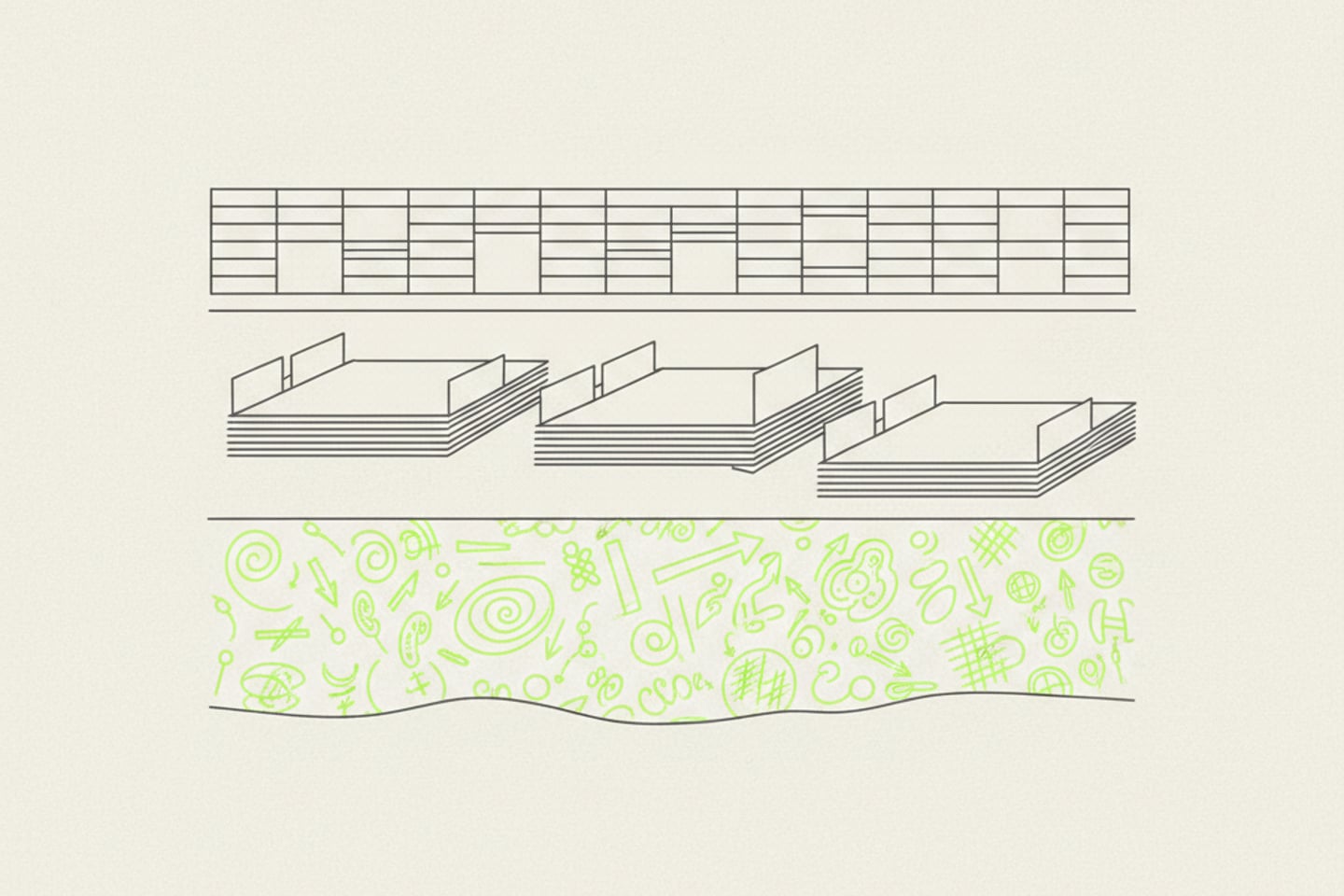
Viewing the enterprise software industry’s evolution as waves explains more than the usual framing does. It treats the industry as a sequence of waves, each defined not by the dominant vendors of its era but by what kind of thing got codified. Each wave produced a generation of category leaders. Each settled into a stable market structure. And each addressed a layer of corporate reality the previous one couldn’t see.
We’re at the start of a third wave. The first codified transactions. The second codified information. The third, just now becoming possible, has to codify the tacit layer: the workarounds, judgment calls, informal practices, and undocumented knowledge that account for most of what actually happens inside an enterprise. This is much harder to codify than transactions or information, which is why it took so long. It’s also where the next generation of enterprise category leaders will be built, because the addressable problem is larger than either of the two preceding waves.
The “third wave” framing has been used loosely in tech writing for years, so let me be specific. The kinds of problems that have remained intractable in enterprise operations all live in the tacit layer: the ones automation has consistently failed at, the ones that resist process improvement, the ones that swallow consulting engagements without producing change. Until the tacit layer becomes legible, those problems stay intractable. The technology to make it legible is now arriving. That changes the shape of the industry.
Wave one: the transaction layer
The first wave of enterprise software ran from roughly the late 1970s through the 1990s. The category-defining products were the general ledger, the ERP, and the CRM. The thing they codified was the corporate transaction: the discrete event in which something of value moved, was recorded, and became auditable.
This was real codification. Before SAP and Oracle Financials and the early enterprise CRMs, the transactional reality of a large company existed in a partially digital, partially paper-based, partially tribal state. Records were kept, but inconsistently. Consolidation across business units was slow. The audit trail depended heavily on the diligence of individual record-keepers. The wave’s contribution was to take this reality and produce a unified, queryable, machine-readable representation of it. The general ledger became a database. The customer record became a database. The supply chain became a sequence of timestamped events.
The vendors that won this wave (SAP and Oracle, with Siebel and later Salesforce extending it to the customer side) built businesses of enormous durability because the thing they codified was load-bearing for everything downstream. Financial reporting, regulatory compliance, supply chain optimization, customer analytics: all of it depended on the transactional substrate being trustworthy. The wave’s investments compounded for thirty years.
What the wave didn’t codify was anything non-transactional. The judgment that produced the transaction wasn’t in the record. The reasoning behind the decision didn’t appear in the audit trail. The variation in how the transaction was actually executed (who was involved, how long it took, what was attempted first, what the workarounds were) was systematically excluded, because the wave’s framing of the world had no place for it.
Wave two: the information layer
The second wave ran from roughly the mid-1990s through the early 2020s. The category-defining products were the data warehouse, the BI platform, the data lake, and eventually the modern cloud data stack: Snowflake, Databricks, dbt, and the constellation around them. The thing being codified was corporate information, broadly construed: the structured and semi-structured data produced by the transactional systems, augmented by external feeds, log streams, sensor data, and the digital exhaust of an increasingly software-mediated business.
This wave was less unified than the first one. It produced more vendors in more sub-categories, with faster turnover. But the underlying motion was consistent: take the data the enterprise was already generating and produce representations of it that supported analysis, reporting, and, increasingly, machine learning. The wave gave us the modern dashboard, the modern KPI culture, the modern data team, and eventually the foundations for the AI capabilities that emerged on top of it.
What this wave didn’t codify, despite frequent claims to the contrary, was the operational reality of how work was performed. Data warehouses are full of information about what happened: the closed deal, the resolved case, the completed transaction. They’re mostly empty on the subject of how it happened. The variation between two cases that ended in the same outcome isn’t in the warehouse. The reasoning that distinguished a successful customer service interaction from an unsuccessful one isn’t in the warehouse. The workarounds the operations team developed last quarter, after a system migration broke a step nobody had documented, aren’t in the warehouse.
This isn’t a criticism of the wave. The wave did what it did. But it left an interesting situation: enterprises with very sophisticated data capabilities, deep AI infrastructure, and well-developed analytics functions, and almost no machine-readable representation of how their own work was actually being performed.
Wave three: the tacit layer
The third wave is the one we are entering. The thing it has to codify is the tacit layer: the operational reality between transactions, the knowledge in the work that has never been written down, the moves that experienced operators make without thinking and that the rest of the organization has no way to learn from.
This is harder than either of the preceding waves, and it’s worth being clear about why. Transactions are intrinsically discrete and recordable; the wave that codified them mostly had to build systems to capture what was already a well-defined event. Information is more diffuse, but it’s at least, by definition, the kind of thing that wants to be captured: already symbolic, already representable, already amenable to storage and query. The tacit layer is neither. It’s the part of work that has resisted symbolic representation since Polanyi wrote about it in 1966. The reason it’s the next frontier is that, until very recently, we had no instruments that could observe it at a useful resolution.
We do now. Continuous, multimodal observation of work (at the screen, across systems, with computer vision and language models layered on top of the raw interaction stream) produces a representation of the tacit layer that wasn’t previously available. The representation is imperfect. It misses things. It still can’t capture everything an experienced operator knows. But it’s good enough, today, to be the substrate for a generation of enterprise software the previous two waves weren’t equipped to build.
Why this re-opens the market
The standard view of enterprise software is that the category is mature, established vendors have won the major workloads, and the industry’s future lies in consolidation and adjacent expansion rather than new platform plays. I think this view is wrong in a specific way, and the tacit-layer argument is why.
Mature markets exist when the codification problems they were built to solve have been solved. The transaction wave is mature because transactions have been codified. The information wave is maturing because information has been substantially codified, even if the work continues. But the tacit layer hasn’t been codified, and the problems that depend on its codification aren’t minor. They’re most of the problems enterprises actually have.
Consider what those problems are. The high cost of operations functions. The persistent gap between operational performance at top-quartile and median firms in the same industry. The chronic failure of automation initiatives to deliver the productivity gains promised. The slow erosion of institutional knowledge as experienced employees retire. The inability to onboard new employees efficiently. The opacity of operational risk to executives and regulators. The difficulty of moving work across geographies without losing quality. The brittleness of automated processes when faced with variant inputs.
Every one of these problems lives in the tacit layer. They’re problems of how work is actually performed: by whom, in what sequence, with what judgments, against what unwritten standards. None of them is well-served by transactional data or by warehoused information. They’ve been intractable for decades because the layer they depend on has been invisible.
When a layer that’s been invisible for forty years becomes visible, the problems that depended on it being invisible become solvable. That’s the re-opening of the market.
What gets built
The new wave will produce its own category leaders, and the shape of what they build is becoming clear. Three things, in particular, seem likely.
A new system of record. The transaction wave gave us the general ledger as a system of record for financial events. The information wave gave us the data warehouse as a system of record for organizational data. The tacit wave will produce a system of record for process execution: a continuously updated representation of how work is being performed across the enterprise, against which agents, humans, and oversight functions all operate. This is the load-bearing artifact of the new wave. Like its predecessors, it will be infrastructure: always-on, owned by a permanent function, and depended on by other systems.
A new vocabulary. Each wave produces its own language. The transaction wave gave us debit and credit, journal and ledger, posted and unposted. The information wave gave us source and target, fact and dimension, ETL and ELT, schema and lineage. The tacit wave is starting to produce its own: agent and skill, intent and context, policy and confidence, outcome and exception. Vocabulary matters because it lets people across vendors, firms, and functions reason about the same things. The standardization of vocabulary is an early move in any wave’s maturation, and it is happening now.
A new operating model. Each wave changes how enterprises organize themselves around the thing being codified. The transaction wave gave rise to the modern finance function and its CFO. The information wave gave rise to the modern data function and its CDO. The tacit wave will produce an analogous function (variously called digital operations, operational intelligence, or the agentic enterprise office) that owns the process record, the agent estate, and the continuous tuning of the operational substrate. It doesn’t yet have a settled name. It will. The CFO role grew out of the back-office controller role before becoming a strategic seat at the table. The first chief data officers, likewise, were stood up to wrangle data governance and compliance, long before the title implied analytics or strategy. The names settle once the function does.
Things to keep in mind
Two cautions: the “third wave” framing invites overstatement, and the topic deserves better.
First, codifying the tacit layer is a more delicate operation than codifying transactions or information was. The tacit layer is where people work. Observation of work, done badly, becomes surveillance. When done well, it requires consent, careful scoping, anonymization where appropriate, and a clear governance framework for what’s captured and how it’s used. The wave will succeed only to the degree it earns the trust of the people whose work is being observed. Vendors that get this wrong won’t just have ethical problems. They’ll be operationally limited, because work observed under duress is work performed badly.
Second, the wave will be less neat than the framing suggests. The first wave is described as “transactions,” but it actually included a great deal that wasn’t transactional: workflow, master data, and organizational structure. The information wave included a lot of work that was structurally similar to transactional work. The tacit wave will overlap with both. The boundaries aren’t crisp. Vendors and analysts will spend the next decade arguing about what counts as which. This is normal. The waves are framing, not ontology.
Where this leaves us
The enterprise software industry has been through two distinct codification cycles, each lasting roughly two decades, each producing durable category leaders, and each addressing a layer of corporate reality the previous one couldn’t reach. We’re at the start of a third cycle. The layer it addresses is the tacit one: the part of corporate reality visible only to the people doing the work, whose codification has been blocked by the absence of instruments capable of observing it.
The instruments are now here. The codification is starting. The category leaders of this cycle are mostly not yet known, though some are visible in early form. The problems the cycle will solve are large enough that the industry, which had begun to feel mature, will feel young again for a while.
For operating leaders, the implication is straightforward: the operational problems that have felt intractable for the last two decades are no longer intractable, and the gap between firms that move on this and firms that don’t will widen quickly. For investors, the implication is that enterprise software isn’t a consolidation story over the next ten years. For the vendors of the last two waves, the implication is that the data they own, transactional and informational, is necessary but not sufficient for what’s coming. The question of how they connect to the new substrate is the most important strategic question they face.
The first wave codified the ledger. The second codified the warehouse. The third will codify the work itself. That’s a larger thing than either of the first two, because work is where most of the value, most of the cost, and most of the operational reality of every large enterprise has always lived.
It’s finally becoming visible. That changes everything downstream.