Issue 20 · August 16, 2026
Future Frontiers · Issue 20
Why the 80% of work that's documented isn't the hard part, what tacit knowledge costs an AI rollout, and a diagnostic for how tellable your own work is.
Polanyi's paradox and the last mile of enterprise AI.
"We can know more than we can tell." Sixty years on, Polanyi's paradox is exactly where enterprise AI stalls: the tacit last mile that resists being written down.
 Read on the web →
Tacit knowledge
What experts know but can't fully describe. The reason enterprise AI rollouts stall at the 20% that wasn't in the SOP.
Read the explainer →Tidbits of levity, fun, and relief from the serious work.
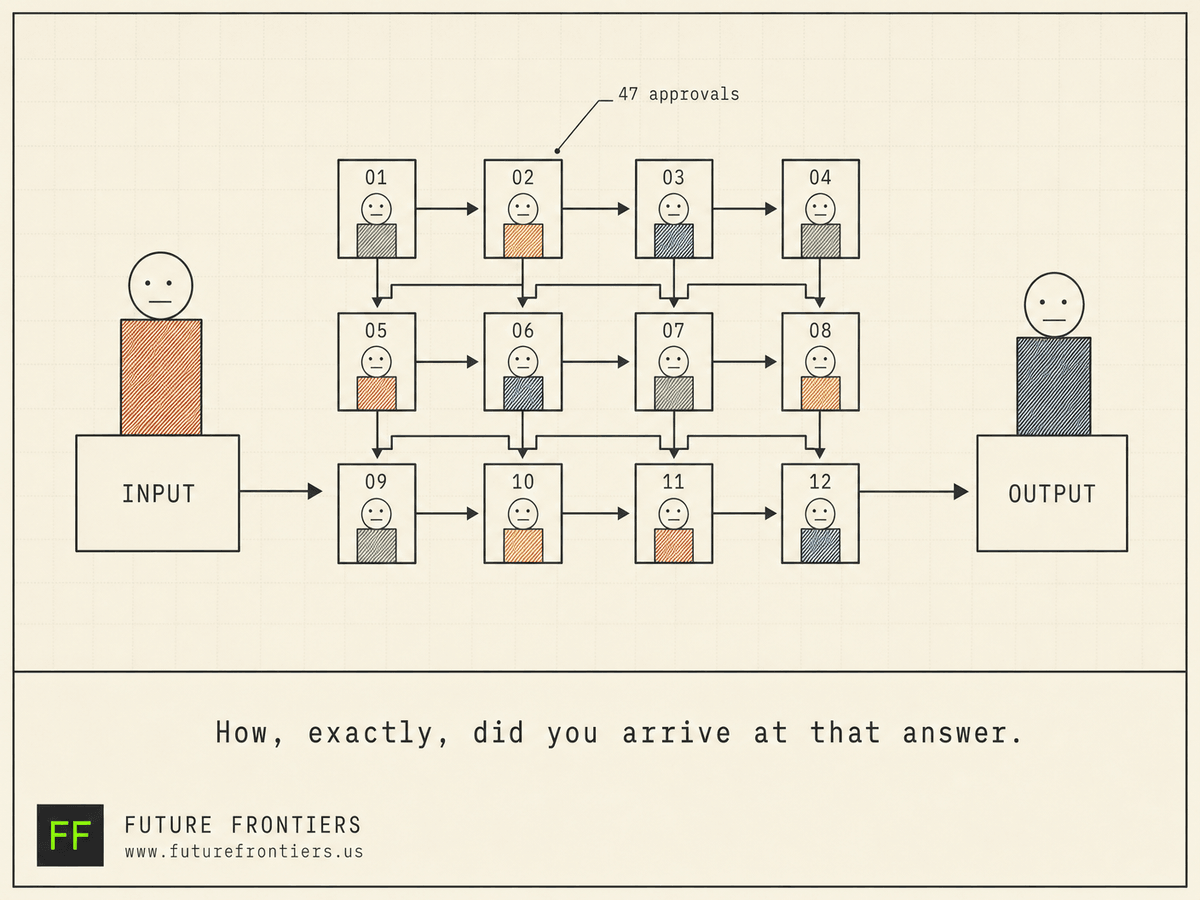
Asking the model to show its work.
How Tellable Is Your Work?
A diagnostic, not a knowledge test. For each pair, pick the line that sounds more like your team.
1.
a) A new hire follows the SOP and produces acceptable work within a week.
b) A new hire takes six months, most of it spent watching seniors handle hard cases.
2.
a) When something goes wrong, we can point to the step that was missed.
b) When something goes wrong, we say, “you have to have seen a few of these.”
3.
a) The documented process and the real one match.
b) Seniors override the documented process, and they are usually right.
4.
a) Quality gaps come down to training, tenure, or effort.
b) Quality gaps are real but hard to explain. “Their work is just better.”
5.
a) The hard part is volume: getting through the cases.
b) The hard part is judgment: knowing which cases need a second look.
Scoring
- Mostly (a). Low tacit content. Your work is well codified. The AI rollout is mostly an integration problem.
- Even split. Mixed. The documented half automates. The judgment half is your moat. Don’t plan them as one project.
- Mostly (b). High tacit content. The visible work is the easy 20%. The rest is the actual job, and it comes from observation, not documents.
SOP-114: How to Ride a Bicycle
SOP-114 · Riding a Bicycle
Owner: Process Excellence · Version 6 · In review since March
Purpose. Document the bicycle riding process so any trained associate can perform it consistently.
Step 1. Sit on the seat.
Step 2. Push the pedals.
Step 3. Do not fall.
Known issue. The pilot group cannot complete Step 3. We asked our subject matter expert what to add. She said, “You just balance.” We asked her to elaborate. She said, “You just… balance.”
Revision v4. Step 3 now reads: if leaning left, steer left; if leaning right, steer right; do not think about either instruction. The revision tested poorly.
Observation study. We watched the expert ride for two hours. She made roughly four hundred small corrections a minute. None of them appear in the SOP. She was aware of none of them, and asked us politely to stop watching.
Recommendation. Close the documentation project. Keep the bicycle.
Training will proceed as it always has: hand the new hire a bicycle, hold the seat, and let go without mentioning it.