
Future Frontiers - Issue 4
In this issue:
Focus Feature: The Autonomy Paradox
Free Resource: Process Automation Opportunity Scanner
Demystifying AI: Transformation Architecture
Leadership Lessons: Socrates and the Power of Questions
Wise Words: Steve Jobs on Technology
Brain Teaser: The Digital Twin Synchronization Problem
Quizzical: The Future of Work
Just In Jest: Human-in-the-Loop Reality
Poll : The Intelligence Shift
Focus Feature:
The Autonomy Paradox
There's a scene that plays out in enterprise boardrooms across Silicon Valley almost daily. The CTO clicks through a sleek presentation showing AI agents handling customer service, processing invoices, and managing supply chains with minimal human oversight. "Imagine," the pitch concludes, "a world where your operations run themselves."
Free Resource:
Process Automation Opportunity Scanner
Process Automation Opportunity Scanner is your strategic compass for navigating the transformation from manual to autonomous execution. This worksheet helps you systematically identify which business processes are ripe for AI automation, moving beyond gut instinct to data-driven decision making.
Demystifying AI:
Transformation Architecture
The Transformer architecture, introduced in the 2017 paper "Attention Is All You Need" by researchers at Google, represents a fundamental paradigm shift in the field of natural language processing (NLP). Before its arrival, the state-of-the-art was dominated by recurrent neural networks (RNNs) and long short-term memory networks (LSTMs), which process data sequentially—one word at a time in the order it appears. This sequential nature was a critical bottleneck; it made training slow and inefficient, and more importantly, it struggled with "long-range dependencies," where the meaning of a word early in a sentence is crucial to understanding a word much later.
Leadership Lessons:
Socrates and the Power of Questions
While I do not claim to be a Socratic scholar, I am a fan of the Socratic method. Socrates, the foundational philosopher of ancient Athens, revolutionized thought not by proclaiming answers but by mastering the art of the question. His famous Socratic method involved engaging with citizens, from statesmen to artisans, in dialogues where he would deconstruct their assumptions through a series of incisive, probing questions. He famously claimed that his only wisdom lay in the recognition of his own ignorance—"I know that I know nothing." This was far from a simple admission of humility; it was a profound strategic tool.
Wise Words:
Steve Jobs on Technology
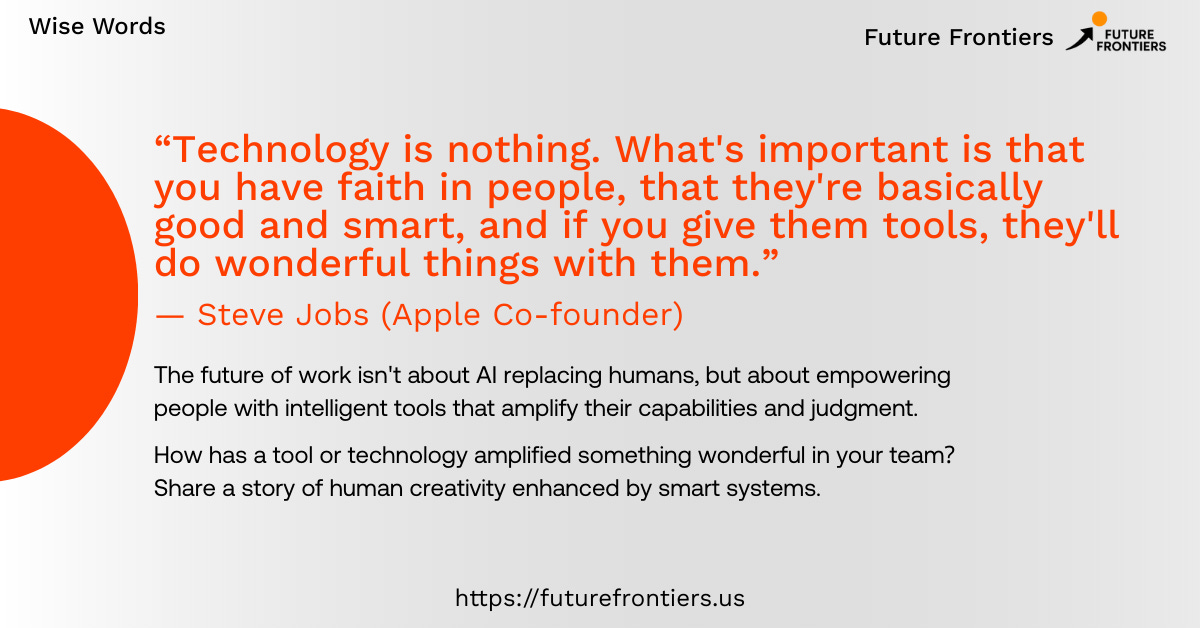
"Technology is nothing. What's important is that you have faith in people, that they're basically good and smart, and if you give them tools, they'll do wonderful things with them." — Steve Jobs (Apple Co-founder)
The future of work isn't about AI replacing humans, but about empowering people with intelligent tools that amplify their capabilities and judgment.
How has a tool or technology amplified something extraordinary in your team? Share a story of human creativity enhanced by intelligent systems.
Brain Teaser :
The Digital Twin Synchronization Problem
A factory has four production lines, each with a digital twin that updates every:
Line 1: Every 2 minutes
Line 2: Every 3 minutes
Line 3: Every 5 minutes
Line 4: Every 7 minutes
If all digital twins synchronize their data at 9:00 am, when will be the next time that all four will have fresh, synchronized data simultaneously?
Quizzical :
The Future of Work
1: By 2030, what percentage of current jobs are expected to be significantly changed by AI?
a) 20-30%
b) 40-50%
c) 60-70%
d) 80-90%
2: Which skill is becoming MOST valuable in the AI era?
a) Technical programming
b) Data analysis
c) Creative problem-solving and emotional intelligence
d) Administrative efficiency
3: What's the concept of "augmented work"?
a) Working longer hours with technology
b) Humans and AI collaborating to enhance capabilities
c) Replacing all human workers
d) Using VR for remote work
4: In the future workplace, what will be humans' primary role?
a) Operating AI systems
b) Data entry and processing
c) Strategic thinking, creativity, and relationship management
d) Quality control only
5: What's "reskilling" in the context of AI adoption?
a) Learning to use new software
b) Developing new competencies for evolving job roles
c) Getting additional academic degrees
d) Learning to manage AI systems technically
Poll :
The Intelligence Shift
Just In Jest :
Human-in-the-Loop Reality
The "human in the loop" turned out to be me frantically clicking "approve" on decisions I don't understand. I'm less "strategic overseer" and more "expensive rubber stamp."