The Algorithm Audit
When autonomous systems run the enterprise in real time, one bad decision can hide in plain sight. The discipline of auditing the algorithms you can no longer see.
 Read on the web →
AI Leadership Style Quiz
A short self-assessment that shows how you lead through AI change, and where your instincts help or get in the way.
Download the resource →Hallucination
When a model states something fluent, confident, and entirely made up. Why it happens, and why it matters most in high-stakes work.
Read the explainer →Tidbits of levity, fun, and relief from the serious work.
The Multi-Agent Resource Allocation
A process automation platform manages server resources across three environments:
- Production: Needs 60% resources minimum, can use up to 80%
- Staging: Needs 15% minimum, can use up to 40%
- Development: Needs 10% minimum, can use up to 30%
During peak load, Production demands 85%, Staging needs 25%, and Development requests 20% (total: 130% of available resources). What’s the optimal allocation strategy that satisfies minimum requirements while being fairest to actual needs?
Answer at the foot of the issue ↓
The Multi-Agent Resource Allocation
There are several ways one can do it. Here is the optimal allocation strategy
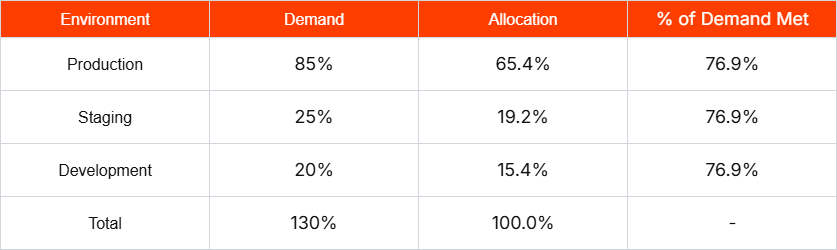
Optimal Allocation (Max-Min Fairness)
How?
Step 1: Recognize total demand (130%) exceeds capacity (100%). Step 2: Apply proportional scaling (max-min fairness) to treat all demands equally:
- Production: 65.4%
- Staging: 19.2%
- Development: 15.4%
Step 3: Verify hard constraints:
- Production 65.4% ≥ 60% min and ≤ 80% max ✓
- Staging 19.2% ≥ 15% min and ≤ 40% max ✓
- Development 15.4% ≥ 10% min and ≤ 30% max ✓
Why This Is Fairest
This is the max-min fair solution: it maximizes the minimum percentage of demand satisfied across all environments (76.9% each).
Alternative strategies (like strict business priority) would allocate Production 75%, Staging 15%, Dev 10% (Production gets 88% of its needs met, but Development only gets 50%). The proportional approach ensures no environment suffers disproportionately—all bear the same 23.1% shortfall relative to their actual needs.