Issue 18 · July 16, 2026
Future Frontiers · Issue 18
The two doors every AI program faces, the 80/15/5 allocation that has worked in the field, and a brain teaser about cycle times that don't drop.
From workflow automation to workflow reimagining.
Every enterprise AI portfolio is a list of existing workflows made faster. The real prize is not automating the work you do. It is asking whether it should exist.
 Read on the web →
Agentic workflow
A process where the agent picks the steps, not just executes them. The dividing line that changes how the workflow must be governed.
Read the explainer →Tidbits of levity, fun, and relief from the serious work.
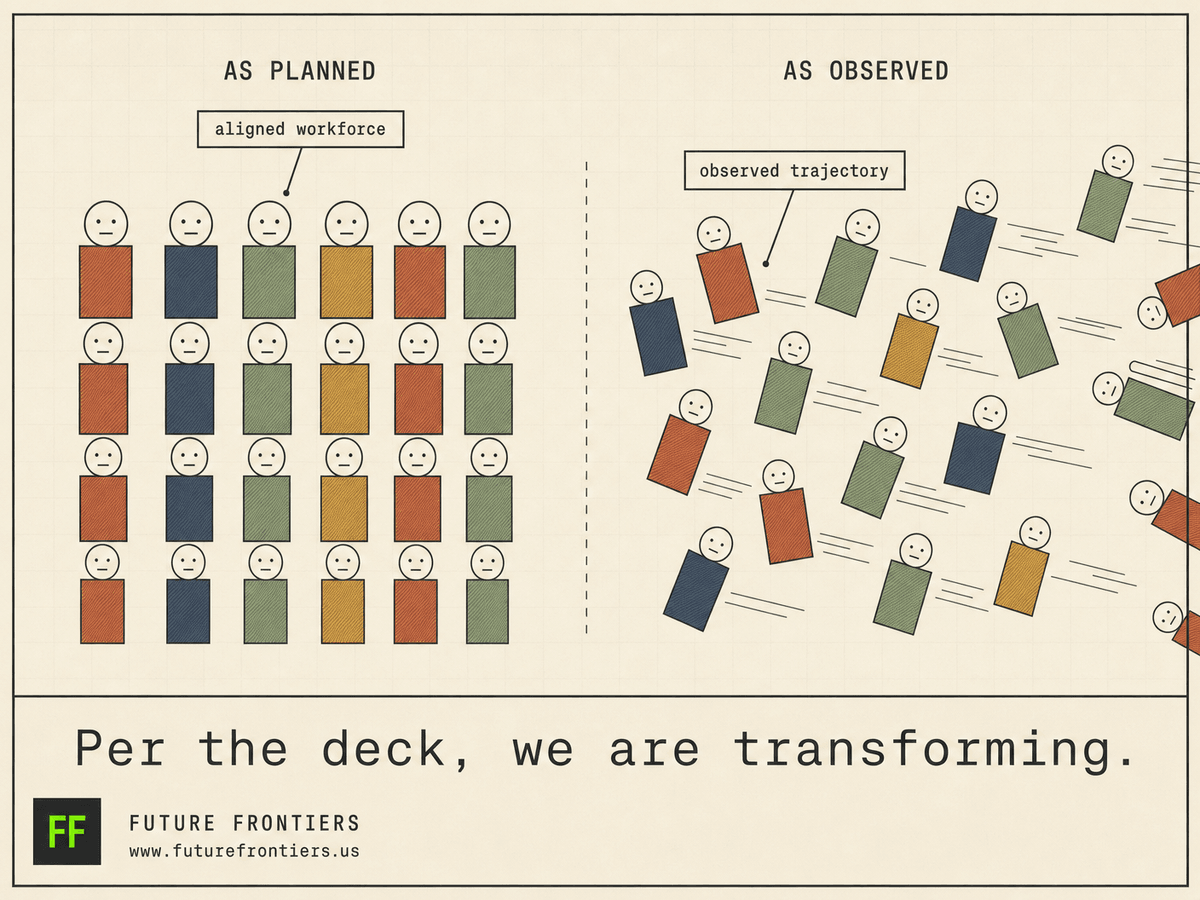
Transformation, as drawn versus as observed.
The Reverse Hammer
A bank’s loan-origination process takes 11 days from application to decision. The team installs an AI agent on the underwriting step, which now takes 8 minutes instead of 6 hours. They roll it out across the organization, celebrate the cycle-time reduction, and report the win to the board.
Six months later, end-to-end cycle time is 10.4 days.
The team is baffled. Where did the savings go?
Answer at the foot of the issue ↓
Hammer & Champy's Group Chat, 2026
Authors of Reengineering the Corporation (1993), reconvening by group chat. Posthumously.
Champy: third consultant this week pitched me “agentic process reengineering”
Hammer: what’s that
Champy: our book, with chatbots
Hammer: so it’s our book
Champy: with chatbots
Hammer: and what are they shipping
Champy: a vendor called Obliterate.AI. it helps you fill out your existing forms faster.
Hammer: that is the exact opposite of obliterating
Champy: they paved the cow paths and added a chatbot that asks the cow for a tip
Hammer: redesign the work, not the tool. it’s on page one.
Champy: they want to call the sequel Obliterate 3.0: The Agentic Edition
Hammer: 🪦
The Reverse Hammer
They didn’t go anywhere — they were never large. Underwriting was 6 hours of an 11-day process. Saving 5.5 hours on a step that’s 2% of the cycle barely moves the total. The other 98% was in document collection, customer back-and-forth, secondary reviews, and queue waits, all unchanged.
This is the Reverse Hammer: applying AI to the visible step while leaving the invisible queue intact. Most boardroom AI wins look like this. The first question on any agent program isn’t can we automate this step? but what fraction of the end-to-end cycle does this step represent? If the answer is less than 10%, you’re optimizing in the wrong place.