Issue 17 · July 1, 2026
Future Frontiers · Issue 17
What changes when the AI takes initiative, the context window that quietly determines what your agent can do, and a five-question readiness check.
From copilots to coworkers.
"Copilot" fit when a human flew and the AI rode shotgun. That model is breaking, and the vocabulary is shifting from copilot to coworker.
 Read on the web →
Context window
How much input a model can see at once. Bigger is partly true, mostly misleading, and always expensive.
Read the explainer →The Seven-Context Checklist
Twenty-one questions that pressure-test whether an agent has what it needs to do its job, paired with the essay 'From copilots to coworkers.'
Download the resource →Tidbits of levity, fun, and relief from the serious work.
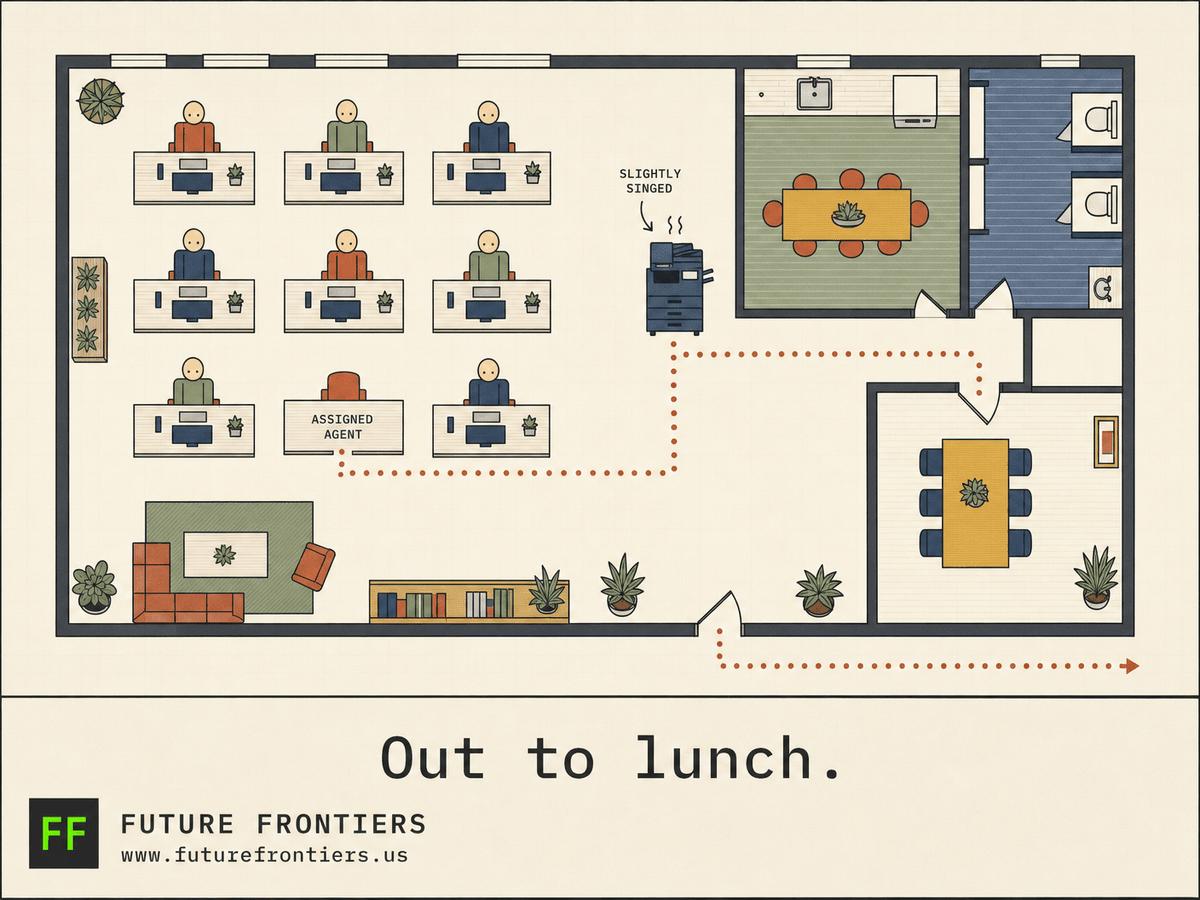
When the agents are, technically, on it.
What's Your Agent Readiness Level?
Five questions. Pick the best answer for each. Scoring at the bottom.
1. Your team wants to deploy an agent to handle inbound customer-service tickets. The most important early investment is:
a) The largest foundation model your budget allows
b) A clearly scoped permissions model — what the agent can read, write, and send
c) A bigger context window so the agent can see more ticket history
d) A custom fine-tune on your historical tickets
2. A vendor pitches their product as “fully agentic.” The strongest screening question is:
a) “What foundation model do you use?”
b) “If we remove the next step from the prompt, does the system still complete the task?”
c) “Is your context window at least 200K tokens?”
d) “Do you support fine-tuning?”
3. Your agent has 95% per-step accuracy across an eight-step process. The end-to-end success rate is approximately:
a) 95%
b) 88%
c) 66%
d) 40%
4. Which is the strongest predictor that an agent deployment will fail in production?
a) The foundation model is from a competitor
b) The team can’t replay the agent’s plan, tools called, and inputs/outputs
c) The agent uses a smaller context window than the latest frontier model
d) The cost per task is higher than the human baseline
5. Six months into deployment, your agent’s average cost-per-task has tripled. The most likely cause is:
a) The vendor raised prices
b) The team is sending more tokens per call than they realize — longer prompts, more tools, deeper retrieval
c) The model got worse
d) Volume increased
Scoring
- 5 correct: Production-ready. You’re thinking about the right problems. Pick your first hard use case.
- 3–4 correct: Pilot-ready. The fundamentals are there; close the specific gaps before scaling.
- 1–2 correct: Foundation-building. Spend a quarter on observability, permissions, and one well-scoped pilot before greenlighting more.
- 0 correct: Hire someone, or hire a partner. The fastest path forward is bringing in someone who has done this once before.
Answer at the foot of the issue ↓
A Copilot's Out-of-Office Reply
Auto-reply from: copilot@yourcompany.com
Hi —
Thanks for your message. I’m currently out of context.
I’ve received your prompt, but my last 47,000 tokens included an entire SQL schema, two HR policy PDFs, and the full text of a deal binder that wasn’t really relevant to your question. I can technically still respond. The relevant parts of your request are now in the middle of my attention span — which, as you may know, is the part I’m worst at remembering.
For the fastest response, please:
- Re-send your question in a fresh thread, without the schema and the PDFs. I will get to it.
- Be specific about what you actually want. “Help me with the report” gives me approximately the same context as “help me with life.” Both are technically answerable.
- Don’t ask me to remember anything from before today. I will say I remember. I will be lying. It will be convincing.
For urgent items, please contact a human, ideally one who has been at the company for more than six months and can still reliably tell you which printer to use.
I expect to be back in context shortly. Or in about 800 milliseconds, whichever comes first.
Best,
Your Copilot
This auto-reply was generated by your Copilot. If the tone seems off, that’s because my system prompt was last updated by someone who has since left the company.
What's Your Agent Readiness Level?
Correct Answer: b) Permissions are the design surface. Model size and context window matter less than what the agent is allowed to touch when it makes a mistake.
Correct Answer: b) If removing the next step breaks the system, it’s an automated workflow with AI components — not an agent. Real agency means the system can plan its own next step.
Correct Answer: c) 0.95⁸ ≈ 0.66. Per-step accuracy compounds. Pick problems with short chains or strong recovery.
Correct Answer: b) Without observability you can’t diagnose failure, can’t tune the loop, and can’t pass an audit. The most common cause of stalled production agents.
Correct Answer: b) Cost surprises in production almost always come from drift in what’s sent to the model, not from the model itself. Audit token-in / token-out per call before suspecting anything else.