Issue 22 · September 16, 2026
Future Frontiers · Issue 22
Why Hammer's "don't automate, obliterate" is back, what it means to test a redesign before you commit to it, and the six minutes of work hiding inside a twelve-hour wait.
Process re-engineering 3.0.
In 1990 Michael Hammer said do not automate, obliterate. A third era of reengineering returns to that idea, this time with agents that can redesign the work itself.
 Read on the web →
Process simulation
Running a proposed redesign against work that already happened, to find out how it would have gone. The cheapest way to kill a bad idea.
Read the explainer →The Process Re-engineering Canvas
A one-page canvas for redesigning a business process for the agentic era, from current state to pain points to how you'd know it worked.
Download the resource →Tidbits of levity, fun, and relief from the serious work.
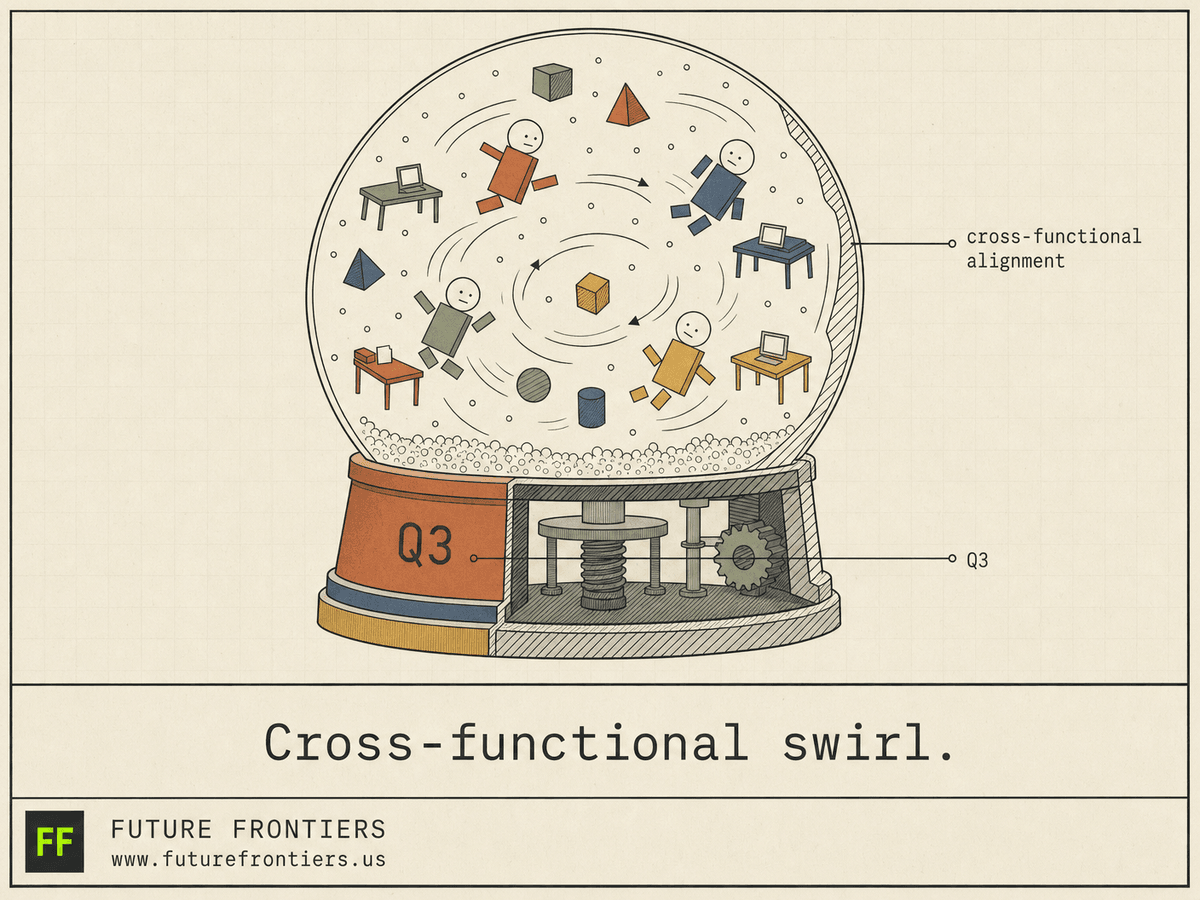
The reorg that rearranges the same pieces.
The Four O'Clock Run
A finance team approves supplier invoices. Each invoice takes six minutes of someone’s attention. Invoices arrive steadily through the working day, and the team clears the pile in one run, every day at 4pm.
They automate the step. Six minutes becomes twenty seconds, and it works exactly as promised.
Suppliers notice nothing. Measured end to end, the process is 0.8% faster.
Where did the improvement go?
Answer at the foot of the issue ↓
An AI Maturity Assessment, Abridged
Complimentary AI Maturity Assessment. 40 questions, 10 minutes. No obligation.
1. Does your organization have a documented AI strategy? ☐ Yes ☐ No
2. Was it developed with external support? ☐ Yes ☐ No — see page 12
3. Who owns AI in your organization? ☐ IT ☐ Operations ☐ A committee ☐ Nobody, which is why you are filling in this form
4–38. Reserved.
39. Have you considered engaging a partner with deep cross-industry transformation experience?
40. Is there a better time to reach you, or is now fine?
Your result: Emerging. Every respondent since 2019 has scored Emerging. A partner will be in touch to discuss your roadmap to Advancing.
The Four O'Clock Run
Into a queue that was always the real cycle time.
An invoice arriving at 3:59pm is handled a minute later. One arriving at 4:01pm waits until the next day’s run. Across a day of steady arrivals the average wait for the run is twelve hours. Add the six minutes of work and end-to-end is 12h06m.
The automation removed 5 minutes 40 seconds from twelve hours and six minutes. That is the 0.8%.
Now the useful part. Leave the six minutes exactly as they are, un-automated, and process each invoice when it arrives instead of at 4pm. End to end goes from 12h06m to six minutes — a 99% cut, from a change that costs no technology at all.
This is Hammer’s argument in one number. The team optimized the part they could see a way to optimize, and the part that actually held the time was a scheduling convention nobody had questioned since it was set. Before automating any step, find out what fraction of the elapsed time that step occupies. If it is under a few percent, you are polishing something invisible.