Issue 16 · June 16, 2026
Future Frontiers · Issue 16
What actually defends an AI program, why most strategy decks weight the three forces wrong, and a brain teaser about why migrations stall.
The model is not the moat.
Three gravities that actually defend an enterprise, and why the layer everyone is arguing about is the one that compounds the least.
 Read on the web →
Foundation model
The pre-trained base every AI feature sits on. Switching it is harder than vendors admit and easier than internal politics suggests.
Read the explainer →Tidbits of levity, fun, and relief from the serious work.
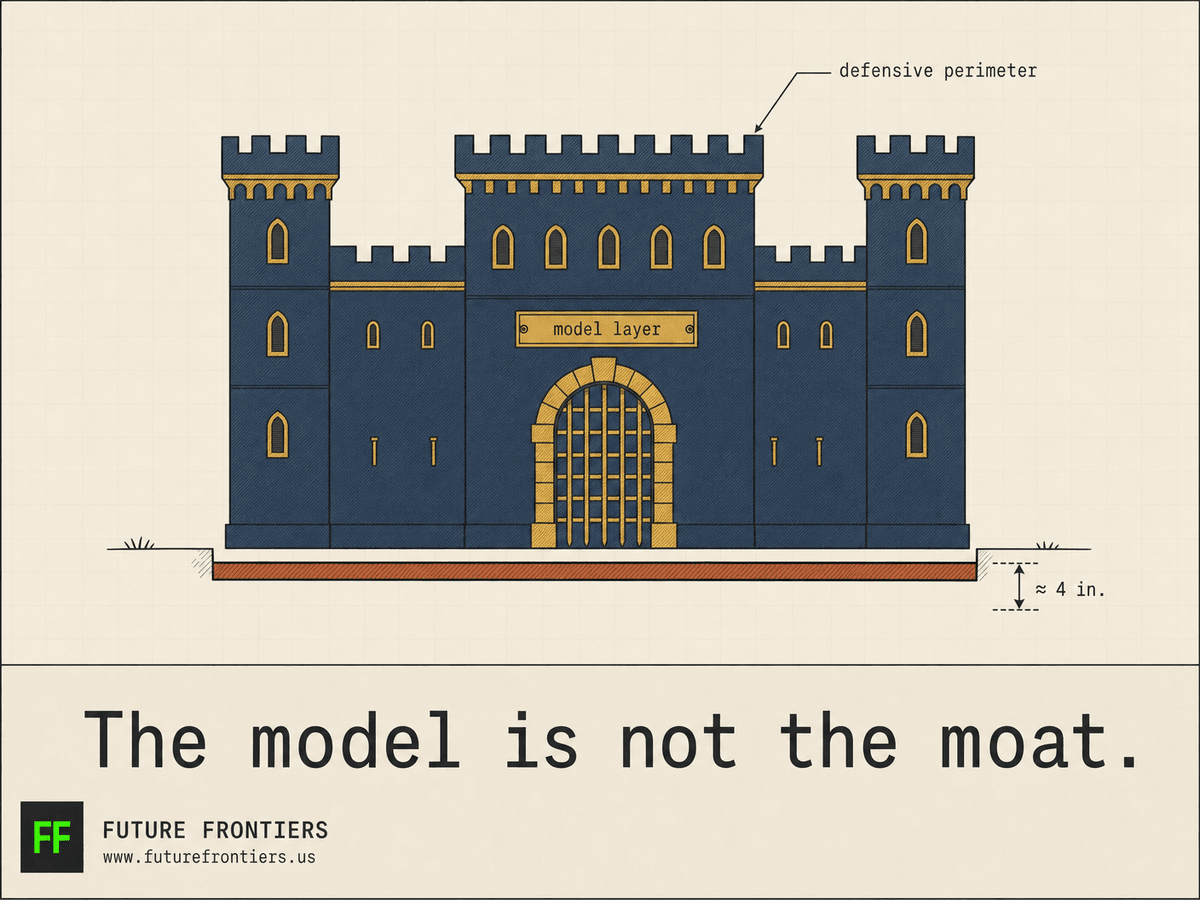
On mistaking the model for the durable advantage.
The Switching Cost Standoff
Your AI platform team estimates that migrating from your current foundation model to a cheaper one with comparable capabilities would take six months and $2M of engineering time. The new model is 40% cheaper per token. Your annual model spend is $12M.
The CFO does the math: $4.8M/year saved, six-month payback, then pure margin. She approves the migration on the spot.
Six months later, the migration is 30% done. Engineering blames the prompt rewrites taking longer than expected. The team that picked the original model is loudest about the integration risks.
What’s actually happening — and what’s the cheapest way to find out?
Answer at the foot of the issue ↓
On the House
Token costs are like office snacks: technically free, somehow $40,000 a month.
The Switching Cost Standoff
The technical work is rarely the bottleneck on a foundation-model migration. The bottleneck is incentives — the team that picked the original model is being implicitly asked to admit their pick is now mid-tier. They won’t say that out loud, so they surface every plausible technical reason to slow down.
The cheapest diagnostic is to take the most senior engineer who didn’t pick the current model and pay them for two weeks to migrate one workflow end-to-end. If they ship in two weeks what the main team hasn’t shipped in six months, the bottleneck isn’t technical.